No surgery and no further imaging.
Home/Conditions/Adrenal tumours
Adrenal tumours · Robotic adrenalectomy
Robotic surgery for adrenal tumours
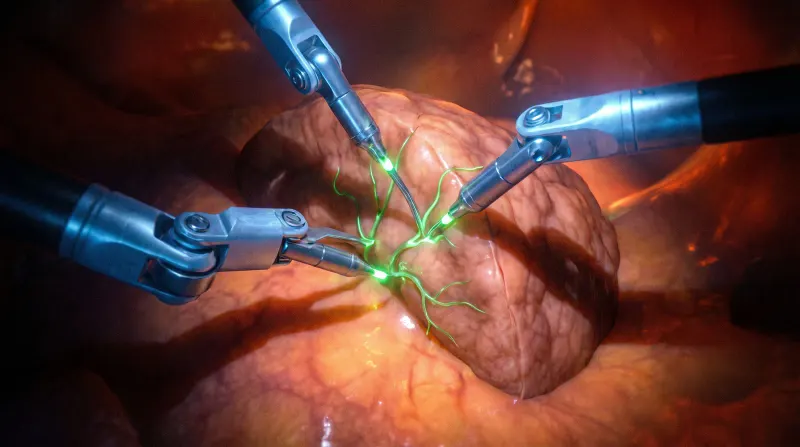
Robot-assisted adrenalectomy removes all or part of an adrenal gland through small ports. Most adrenal masses found by chance are benign and need no operation. Surgery is considered when a mass makes too much hormone, looks suspicious on imaging, or is a pheochromocytoma.
 Written and reviewed by Prof. Dr. Mutlu Ateş, urologist, Antalya American Hospital. More than 1,000 robotic operations. Updated 9 October 2026.

In short
What to know first
- A homogeneous mass measuring 10 Hounsfield units or less on unenhanced CT is benign and needs no further imaging, whatever its size (European Society of Endocrinology guideline, 2023).
- Every patient needs hormone tests: plasma or urinary metanephrines, and a 1 mg overnight dexamethasone test with a cortisol cut-off of 50 nmol/L (1.8 µg/dL).
- Only masses larger than 4 cm that are inhomogeneous or measure over 20 Hounsfield units carry a risk of cancer high enough that surgery is the usual choice.
- Compared with laparoscopy, robotic adrenalectomy gives closely similar results at a higher cost, so the choice depends on the tumour and the anatomy.
28studies in the meta-analysis of robotic versus laparoscopic adrenalectomy (Cancers 2025)
10 HUor less on unenhanced CT: a homogeneous mass is benign (ESE guideline 2023)
625patients in the international registry of bilateral pheochromocytoma (JAMA Netw Open 2019)
23.5%adrenal insufficiency after attempted cortex-sparing surgery, against all patients after total removal
Deciding on treatment
Which adrenal masses need surgery
The decision follows two questions: does the mass make hormone, and could it be malignant. Every case with uncertain findings is discussed by a team of endocrinology, radiology and surgery.
Called mild autonomous cortisol secretion when there are no signs of Cushing syndrome. Blood pressure and diabetes are checked and treated. Surgery is considered individually when related illnesses are present.
When one gland is shown to be the source, adrenalectomy on that side is the treatment.
Surgery is the treatment. Medication to block the hormone effect is required before the operation, and genetic testing is considered for every patient.
Surgery is the usual choice after team discussion. A minimally invasive approach is used up to 6 cm when there is no sign of local invasion.
Open surgery by a team experienced in adrenal and cancer surgery, aiming at complete removal in one piece.
The operation
How robotic adrenalectomy is done
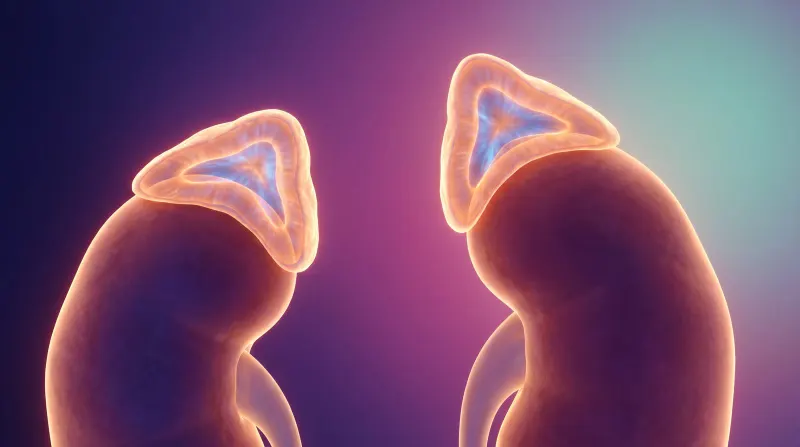
The operation is performed under general anaesthesia with the da Vinci Xi system. The adrenal glands lie on top of the kidneys, next to the vena cava on the right and the aorta on the left, and the adrenal vein is controlled early in pheochromocytoma.
Transperitoneal route
Through the abdominal cavity with the patient on the side. It gives a wide working space and clear landmarks.
Posterior retroperitoneal route
From the back, without entering the abdominal cavity. It is useful after previous abdominal surgery and when both glands are operated. The choice depends on tumour size, position and the surgeon's experience.
Cortex-sparing (partial) adrenalectomy
Only the tumour is removed and working cortex is left, mainly for pheochromocytoma on both sides or in a single remaining gland. In a registry of 625 patients, adrenal insufficiency followed attempted cortex-sparing surgery in 23.5%, against every patient after total removal. A new tumour appeared in the remaining gland in 13% after a median of 8 years, and all were treated with another operation.
Preparation for pheochromocytoma
Blood pressure medication that blocks the hormone effect is started before surgery, with a high-salt diet and fluids to prevent low blood pressure afterwards (Endocrine Society guideline).
Evidence
What the studies show
Robotic versus laparoscopic adrenalectomy (meta-analysis of 28 studies)
| Measure | Result |
|---|---|
| Transfusion, death within 30 days | No significant difference |
| Complications during and after surgery, readmission | No significant difference |
| Positive (R1) margin, operating time | No significant difference |
| Blood loss, conversion to open surgery | Slightly lower with robotic surgery |
| Time to bowel recovery, hospital stay | Slightly shorter with robotic surgery |
| Cost of the hospital stay | About USD 4,101 higher with robotic surgery |
The authors conclude that robotic adrenalectomy is safe and comparable to laparoscopy, and that further studies are needed.
Where the robotic approach helps
- Fine dissection near large vessels. Wristed instruments and a magnified view help beside the vena cava and the adrenal vein.
- Slightly less blood loss and fewer conversions to open surgery in the pooled data.
- Partial adrenalectomy. Precise work helps when cortex is to be kept. Prof. Ateş has published on robotic bilateral partial adrenalectomy.
What to keep in mind
- Results close to laparoscopy. Complications, margins and operating time did not differ.
- Higher cost.
- Not for invasive cancer. Adrenocortical carcinoma with local invasion is an open operation.
- Pheochromocytoma needs preparation and an anaesthesia team experienced with it.
After surgery
Recovery and follow-up
Recovery depends on the type of tumour as much as on the operation.

- First day
Walking and eating start early. After pheochromocytoma, blood pressure is monitored closely.
- After cortisol-producing tumours
Hydrocortisone is given and reduced gradually while the other gland recovers.
- After aldosterone-producing tumours
Blood pressure medication and potassium are reviewed.
- Long term
Follow-up depends on the diagnosis. After pheochromocytoma, lifelong follow-up is suggested.
Questions
Frequently asked questions
Does every adrenal mass need surgery?
No. According to the 2023 European Society of Endocrinology guideline, a homogeneous mass of 10 Hounsfield units or less on unenhanced CT is benign and needs no further imaging, and surgery is not usually indicated for a non-functioning mass with clearly benign features. Hormone tests are still needed for every patient.
What is mild autonomous cortisol secretion?
It describes a cortisol level above 50 nmol/L (1.8 µg/dL) after a 1 mg overnight dexamethasone test in a patient without signs of Cushing syndrome. The 2023 European Society of Endocrinology guideline links it to a higher risk of illness and advises screening for high blood pressure and type 2 diabetes. Surgery is considered individually.
Why is preparation needed before pheochromocytoma surgery?
A pheochromocytoma releases adrenaline-type hormones, and handling it can cause sharp swings in blood pressure. The Endocrine Society guideline recommends medication to block these effects before surgery for every patient with a hormone-producing tumour, with a high-salt diet and fluids to prevent low blood pressure after the tumour is removed.
What is cortex-sparing adrenalectomy?
It removes the tumour and leaves working adrenal cortex, to avoid lifelong steroid replacement. It is used mainly for pheochromocytoma on both sides or in a single gland. In a registry of 625 patients (JAMA Network Open 2019), adrenal insufficiency occurred in 23.5% after attempted cortex-sparing surgery, and 13% developed a new tumour in the remnant.
Is robotic adrenalectomy better than laparoscopic?
The results are close. A 2025 meta-analysis of 28 studies (Cancers) found no significant difference in complications, transfusion, margins or operating time. Blood loss, conversion to open surgery and hospital stay were slightly lower with the robot, and the cost was about USD 4,101 higher.
Is robotic surgery suitable for adrenocortical carcinoma?
Not when there are signs of local invasion. The European Society of Endocrinology guidelines recommend that surgery for suspected adrenocortical carcinoma is done by surgeons experienced in adrenal and cancer surgery, aiming at complete removal in one piece. A minimally invasive approach is reserved for suspicious masses up to 6 cm without local invasion.
Sources
The studies behind this page
- Esposito G, et al. Robotic versus laparoscopic adrenalectomy: meta-analysis. Cancers (Basel). 2025;17(1):150.
- Fassnacht M, et al. European Society of Endocrinology guidelines on adrenal incidentalomas. Eur J Endocrinol. 2023;189(1):G1-G42.
- Fassnacht M, et al. European Society of Endocrinology guidelines on adrenocortical carcinoma. Eur J Endocrinol. 2018;179(4):G1-G46.
- Lenders JWM, et al. Pheochromocytoma and paraganglioma: Endocrine Society guideline. J Clin Endocrinol Metab. 2014;99(6):1915-1942.
- Neumann HPH, et al. Total versus cortical-sparing adrenalectomy in bilateral pheochromocytoma. JAMA Netw Open. 2019;2(8):e198898.
- Ates M, Akin Y. Robotic bilateral partial adrenalectomy. World J Urol. 2021;40(2):607-609.
Other conditions