Robotic partial nephrectomy. Active surveillance in selected older patients or those with other illnesses. Ablation when the surgical risk is high.
Home/Conditions/Kidney tumours
Kidney tumours · Robotic partial nephrectomy
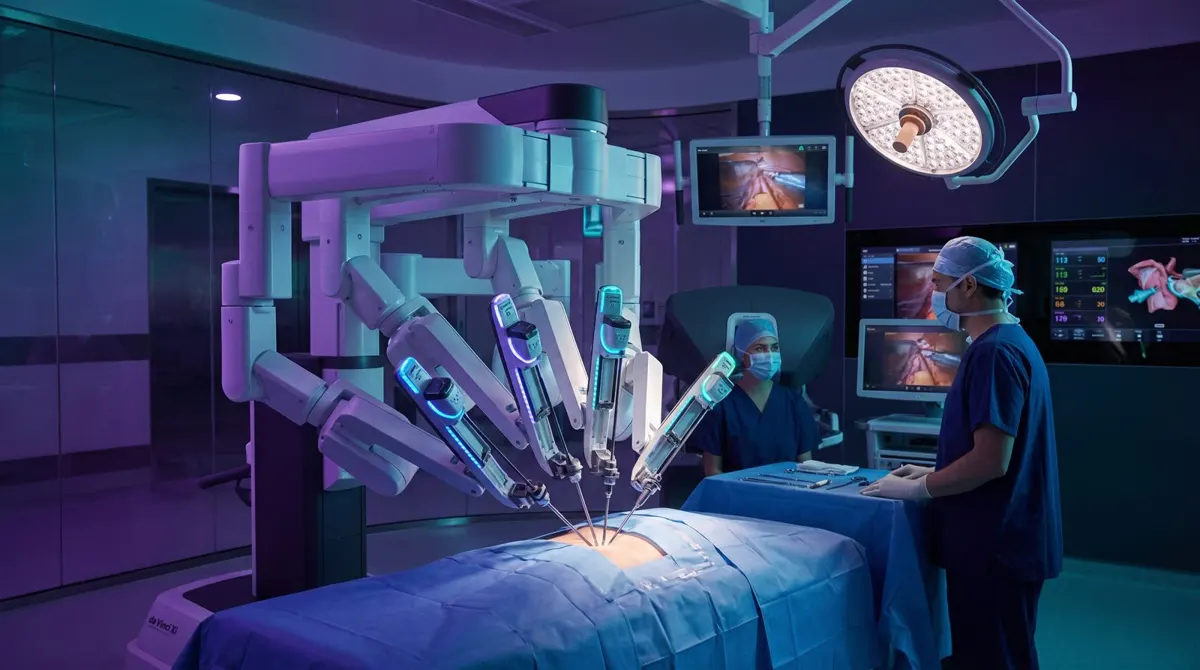
Robotic surgery for kidney tumours
Robot-assisted partial nephrectomy removes the tumour with a clear margin and keeps the rest of the kidney. For tumours up to 7 cm that are confined to the kidney (cT1), kidney-sparing surgery is the first choice whenever it is technically possible.
 Written and reviewed by Prof. Dr. Mutlu Ateş, urologist, Antalya American Hospital. More than 1,000 robotic operations. Updated 9 October 2026.
In short
What to know first
- Most kidney tumours are now found by chance, small and without symptoms, on a scan done for another reason. The aim is to remove the tumour and keep as much kidney function as possible.
- In the randomised OpeRa trial, robotic surgery gave less pain, a shorter hospital stay and better quality of life in the first month than open surgery. The difference in 30-day complications was not significant.
- Compared with laparoscopy, robotic surgery had fewer conversions, complications and positive margins in a pooled analysis of retrospective studies.
- Small masses do not always need immediate treatment: active surveillance and ablation are options for selected patients.
240patients in the randomised OpeRa trial of robotic versus open surgery (Ann Oncol 2025)
4,919patients in the robotic versus laparoscopic meta-analysis (J Urol 2016)
81%trifecta success with the retroperitoneal route for tumours at the back of the kidney (PADORA)
0.09 cmmedian growth per year of small kidney masses on active surveillance (DISSRM)
Deciding on treatment
Treatment by tumour size and stage
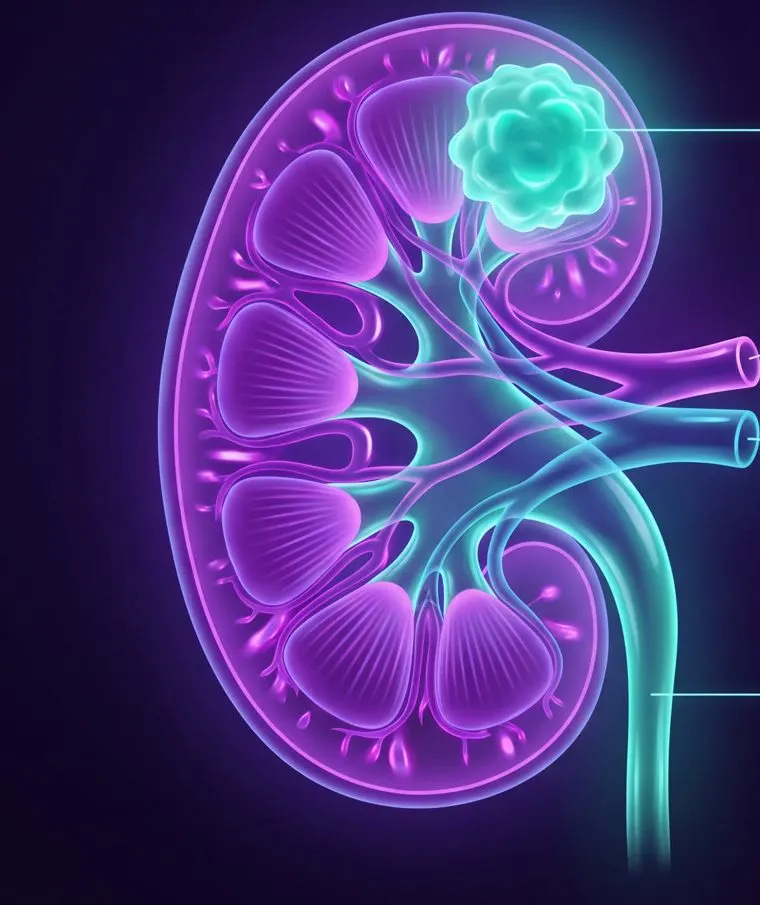
Size, extension beyond the kidney or into a vein, position, age, other illnesses and kidney function all shape the plan. This is a general map; each case is decided individually.
Partial nephrectomy when technically possible. Radical nephrectomy if it is not.
Usually radical nephrectomy. Partial nephrectomy in selected cases, such as a single kidney or reduced kidney function.
Radical nephrectomy, with removal of a tumour thrombus from the renal vein or vena cava when needed.
Seven centimetres is the line between T1 and T2 in staging. It is not an absolute limit for kidney-sparing surgery.
The operation
How robotic partial nephrectomy is done
The operation is performed under general anaesthesia with the da Vinci Xi system. The route is chosen from the position and size of the tumour, its RENAL or PADUA complexity score and its relation to the kidney vessels.
Transperitoneal route
Through the abdominal cavity, with a wide working space. Preferred for most tumours at the front or side of the kidney.
Retroperitoneal route
From the back, without entering the abdominal cavity. In the PADORA study of tumours at the back of the kidney, trifecta success was 81% with this route and 71% with the transperitoneal route, with a shorter operation and less blood loss.
Steps of the operation
The kidney and its vessels are exposed, the tumour edge is mapped with ultrasound during surgery, the tumour is removed with a thin rim of healthy tissue, and the collecting system and kidney are repaired with sutures.
Warm ischaemia time
The kidney artery may be clamped briefly to limit bleeding; the classic target is under 25 minutes. In the randomised CLOCK trial, kidney function did not differ between clamped and unclamped surgery in patients with two normal kidneys. Up to 10 minutes had no effect; beyond that the effect was statistically significant but small.
Evidence
What the studies show
Robotic versus open (OpeRa, randomised)
| Measure | Open | Robotic |
|---|---|---|
| Complications within 30 days | 46% | 37% (difference not significant) |
| Pain and opioid use | Reference | Lower |
| Hospital stay | Reference | Shorter |
| Quality of life in the first 30 days | Reference | Better |
| Operating time | Reference | Longer |
| Warm ischaemia time | Reference | Longer |
Robotic versus laparoscopic (meta-analysis of 25 retrospective studies)
| Measure | Result with robotic surgery |
|---|---|
| Conversion to open or radical surgery | Relative risk 0.36 |
| Any complication | Relative risk 0.84 |
| Major complication | Relative risk 0.71 |
| Positive surgical margin | Relative risk 0.53 |
| Warm ischaemia time | 4.3 minutes shorter |
| Operating time, blood loss, change in kidney function | Similar |
OpeRa was stopped early because recruitment was slow, so its statistical power is limited. The laparoscopy comparison contains no randomised evidence.
Where the robotic approach helps
- Easier recovery than open surgery. Less pain, less opioid use and a shorter stay in OpeRa.
- Controlled suturing. Wristed instruments help in repairing the kidney after the tumour is removed.
- Complex tumours. For tumours deep in the kidney or near the vessels, margins and local recurrence were similar to simple tumours in a meta-analysis of 8,572 patients.
- A route from the back. The retroperitoneal option suits tumours on the posterior surface.
What to keep in mind
- Time. Operating time and warm ischaemia were longer than with open surgery in OpeRa.
- Complex tumours carry more risk. Longer surgery, more blood loss and more major complications (odds ratio 1.57).
- Urine leak and bleeding are the most frequent serious complications.
- High vena cava thrombus. At level III to IV, serious complications reached 41% versus 15% at lower levels in one centre.
After surgery
Recovery and kidney function
The long-term gain of partial nephrectomy is the kidney tissue that is kept. Kidney function is followed with blood tests.

- Day 1 to 2
Close monitoring. The urinary catheter is usually removed.
- Day 2 to 4
Discharge from hospital. Short walks and a gradual return to daily tasks.
- Week 2 to 3
Light and desk work. No heavy lifting for 6 weeks.
- Month 3
First follow-up imaging and kidney function test, then regular follow-up.
Questions
Frequently asked questions
Why is it important to keep the kidney?
Keeping healthy kidney tissue aims to lower the long-term risk of chronic kidney disease. For small tumours, cancer control is similar after partial and radical nephrectomy, so the European Association of Urology guideline recommends partial nephrectomy for cT1 tumours whenever it is technically feasible.
What did the OpeRa trial show?
OpeRa randomised 240 patients with moderately or highly complex tumours (RENAL score 7 or more) in 12 German centres to robotic or open partial nephrectomy. Complications within 30 days were 37% and 46%, a difference that was not significant. Robotic surgery took longer, with longer ischaemia, and gave a shorter stay, less pain and better early quality of life.
How much does warm ischaemia time matter?
It is the time the kidney artery stays clamped while the tumour is removed, classically kept under 25 minutes. In the randomised CLOCK trial of 324 patients with two normal kidneys, clamped and unclamped surgery gave the same kidney function. With a single kidney or chronic kidney disease, selective clamping or an unclamped technique is preferred.
Is active surveillance an option for a small kidney mass?
For selected patients, yes. In the DISSRM registry of 497 patients with masses of 4 cm or less, five-year cancer-specific survival was 100% with surveillance and 99% with immediate treatment, and median growth was 0.09 cm a year. Surveillance suits older patients, those with serious illnesses and small tumours, with regular imaging.
When is ablation used?
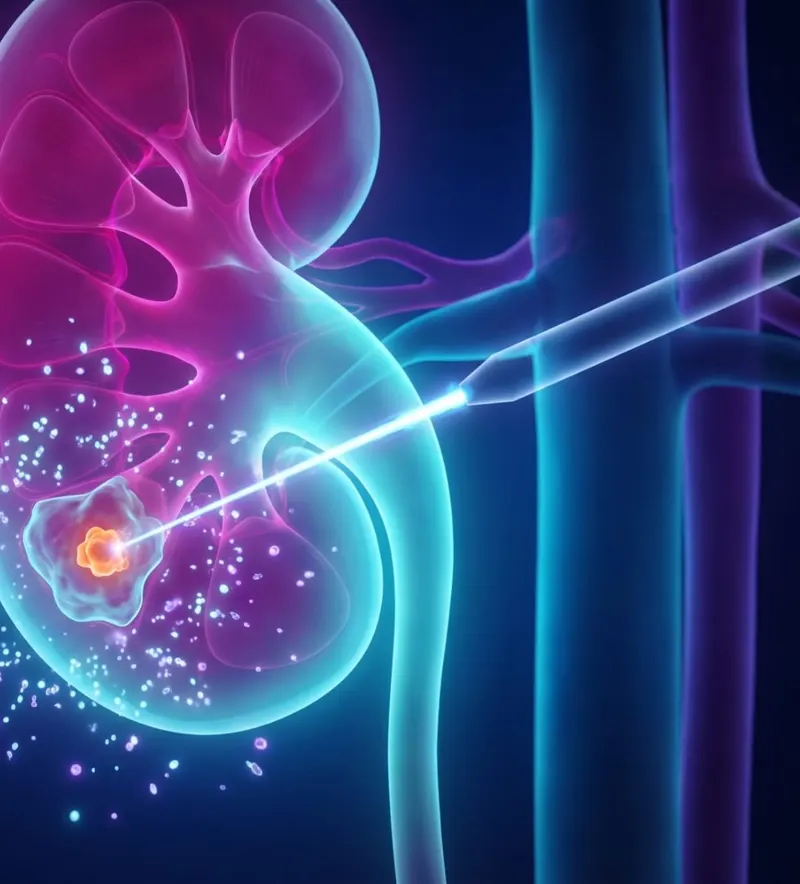
Cryoablation and radiofrequency ablation are options for small tumours when surgical risk is high. In a 2025 meta-analysis of 133 studies (Lancet Oncology), five-year local control was 92% with radiofrequency ablation, 90% with cryoablation and 95% with stereotactic radiotherapy, with serious side effects in 1 to 3%. These studies did not compare ablation with surgery directly.
When does the whole kidney have to be removed?
When partial nephrectomy is not suitable: usually for tumours larger than 7 cm, or tumours growing into the surrounding fat or the renal vein. If tumour extends into the vena cava, a thrombectomy is added. At level III to IV extension the risk rises clearly, with serious complications in 41% versus 15% in a ten-year single-centre series (Ann Surg Oncol 2024).
Sources
The studies behind this page
- Grimm MO, et al. OpeRa. Ann Oncol. 2025;36(8):988-998.
- Leow JJ, et al. Robotic versus laparoscopic partial nephrectomy: meta-analysis. J Urol. 2016;196(5):1371-1377.
- Gao, et al. Endophytic and hilar tumours: meta-analysis. J Robot Surg. 2025;19(1):144.
- Mjaess G, et al. PADORA. Minerva Urol Nephrol. 2023;75(4):434-442.
- Antonelli A, et al. CLOCK. BJU Int. 2022;129(2):217-224.
- Antonelli A, et al. CLOCK: warm ischaemia and kidney function. World J Urol. 2023;41(5):1337-1344.
- Pierorazio PM, et al. DISSRM, five-year results. Eur Urol. 2015;68(3):408-415.
- Uzosike AC, et al. DISSRM growth kinetics. J Urol. 2018;199(3):641-648.
- Huang RS, et al. Ablative treatments: meta-analysis. Lancet Oncol. 2025;26(3):387-398.
- Dell'Oglio P, et al. Level III to IV versus I to II thrombectomy. Ann Surg Oncol. 2024;31(12):8383-8393.
- EAU Guidelines on Renal Cell Carcinoma, 2026.
Other conditions