Active surveillance comes first. Surgery or radiotherapy if surveillance is not suitable or the patient prefers treatment.
Home/Conditions/Prostate cancer
Prostate cancer · Robotic radical prostatectomy
Robotic surgery for prostate cancer
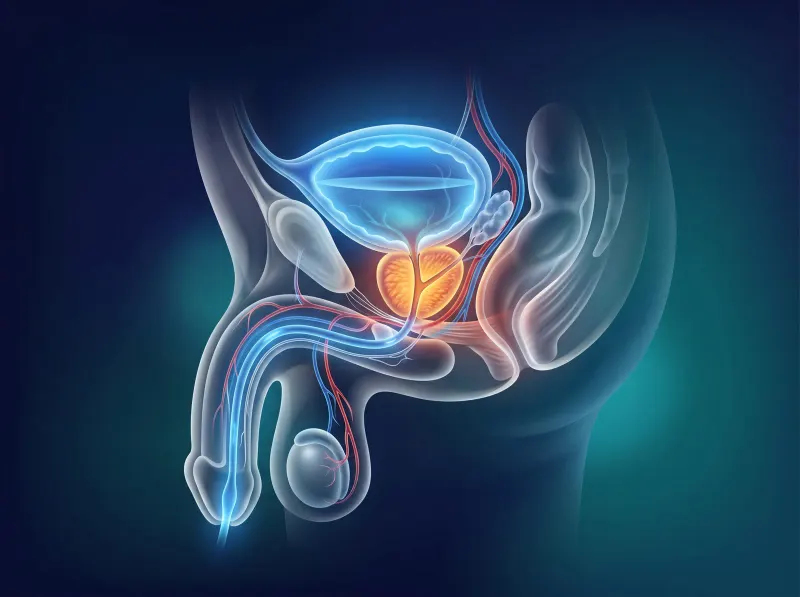
Robot-assisted radical prostatectomy removes the prostate and seminal vesicles through small ports. It is a standard option for intermediate- and high-risk cancer confined to the prostate. The aim is to remove the cancer completely while protecting urinary control and erections as far as the disease allows.
 Written and reviewed by Prof. Dr. Mutlu Ateş, urologist, Antalya American Hospital. More than 1,000 robotic operations. Updated 9 October 2026.

In short
What to know first
- Many prostate cancers grow slowly, and not every man needs surgery. The decision rests on PSA, biopsy grade (ISUP), MRI, age and life expectancy.
- In the randomised Brisbane trial, urinary and sexual function 12 weeks after surgery were similar with the robotic and the open operation.
- In the Swedish LAPPRO study, death from prostate cancer at 12 years was lower after robotic surgery (2.0% versus 4.5%). The study was not randomised, so this needs careful reading.
- NeuroSAFE, a frozen-section check during the operation, improved erectile function scores at 12 months in a randomised trial.
3,583men followed for 12 years in LAPPRO (Eur Urol Oncol 2025)
381men in the randomised NeuroSAFE PROOF trial (Lancet Oncol 2025)
326men in the randomised robotic versus open trial (Lancet 2016)
8,101men in the multicentre analysis of surgeon experience (Eur Urol Oncol 2023)
Deciding on treatment
Treatment by risk group
For cancer confined to the prostate, the risk group is set by PSA, ISUP grade and clinical stage, following the European Association of Urology classification. This is a general map. The decision is made for each patient.
Robotic radical prostatectomy, or radiotherapy with short-course hormone therapy if needed. Surveillance in selected favourable cases.
Robotic radical prostatectomy with lymph node dissection, or radiotherapy with long-course hormone therapy.
Surgery in selected patients, usually as one part of combined treatment. Radiotherapy with hormone therapy.
When life expectancy is under 10 years, the benefit of surgery becomes smaller.
The operation
How robotic radical prostatectomy is done
The operation is performed under general anaesthesia with the da Vinci Xi system, in a head-down position. The prostate and seminal vesicles are removed, pelvic lymph nodes are cleared according to the risk group, and the bladder is joined to the urethra again.
Transperitoneal approach
The most common route, through the abdominal cavity, with a wide working space.
Extraperitoneal approach
The abdominal cavity is not entered. It can be preferred after previous abdominal surgery.
Retzius-sparing approach
The prostate is reached from behind the bladder. Earlier return of continence has been reported; in randomised trials the difference fades by 6 and 12 months. Tumours at the front of the prostate need care with the surgical margin.
NeuroSAFE
After the prostate is removed, the edges beside the nerve bundles are examined by frozen section. If the edge is clear the nerve is kept; if tumour is found, more tissue is taken on that side. In NeuroSAFE PROOF the 12-month IIEF-5 score was 12.7 versus 9.7, continence was better at 3 months and equal at 6 months, and serious adverse events were 3% in both groups.

Evidence
What the studies show
Robotic versus open radical prostatectomy
| Measure | Open | Robotic | Source |
|---|---|---|---|
| Urinary function score at 12 weeks | 83.8 | 82.5 (no difference) | Brisbane, randomised |
| Sexual function score at 12 weeks | 35.0 | 38.9 (no difference) | Brisbane, randomised |
| Adverse events during surgery | 8% | 2% | Brisbane, randomised |
| Complications after surgery | 9% | 4% (p=0.052) | Brisbane, randomised |
| Positive surgical margin | 10% | 15% (not significant) | Brisbane, randomised |
| Death from prostate cancer at 12 years | 4.5% | 2.0% (hazard ratio 0.36) | LAPPRO, not randomised |
| Death from any cause at 12 years | 16% | 14% (hazard ratio 0.81) | LAPPRO, not randomised |
In LAPPRO, differences between the patients in the two groups may have influenced the result.
Where the robotic approach helps
- Fewer problems around the operation. Adverse events during surgery and complications afterwards were less frequent in the randomised trial.
- Fine work in the deep pelvis. A magnified 3D view and wristed instruments help around the nerves and the sphincter.
- A pathology-based nerve-sparing decision. NeuroSAFE checks the margin before the nerve is kept.
What to keep in mind
- Early function is not settled. Urinary and sexual function at 12 weeks were similar to open surgery in the Brisbane trial; a second randomised trial found earlier recovery with the robot.
- Cancer control. The long-term advantage comes from a non-randomised study.
- Position and cost. The operation needs a long head-down position and costs more.
- Experience. The authors of the randomised trial advise choosing an experienced surgeon over a particular method.
After surgery
Recovery and follow-up
Continence usually improves over weeks to months, and erections after nerve-sparing surgery return gradually over months, supported by medication and penile rehabilitation when needed.

- Day 1 to 3
Walking and eating early, then discharge from hospital.
- Day 7 to 10
The urinary catheter is removed. Pelvic floor physiotherapy after removal can contribute greatly to the recovery of urinary control.
- Week 4 to 6
First PSA test. Return to everyday activity.
- First year
PSA every 3 months. Continence and erections are reviewed.
Patients from abroad can fly home with the catheter in place: the medical report needed for the flight is prepared for you. At home, your family doctor or your own urologist can remove the catheter on the planned day, and you are given a medical letter for them. If you prefer, you can stay in Antalya until it is removed.
Questions
Frequently asked questions
Who is a candidate for robotic radical prostatectomy?
Men with intermediate- or high-risk cancer confined to the prostate and a life expectancy over 10 years, and selected men with locally advanced disease. For low-risk cancer, the European Association of Urology guideline puts active surveillance first. Extensive previous abdominal surgery is a relative obstacle, and an extraperitoneal approach can be considered in that case.
Is robotic prostatectomy better than open surgery?
The trials do not fully agree. In the randomised Brisbane trial, urinary and sexual scores at 12 weeks did not differ, and adverse events during surgery (2% versus 8%) were less frequent with the robot. A second randomised trial of 327 men found higher continence with the robot at 3 months (80.5% versus 64.7%). In LAPPRO, death from prostate cancer at 12 years was 2.0% versus 4.5%, but that study was not randomised.
What is NeuroSAFE?
It is a frozen-section examination of the tissue edge beside the nerve bundles, done during the operation. In the randomised NeuroSAFE PROOF trial of 381 men, the IIEF-5 erectile function score at 12 months was 12.7 with NeuroSAFE and 9.7 with standard surgery. Continence was better at 3 months, and serious adverse events did not increase.
How long does urine leakage last after surgery?
Leakage is common in the first weeks and improves clearly over the following months. Age, prostate size, the technique and whether the nerves were spared all affect the speed of recovery. Starting pelvic floor exercises before the operation helps, and pelvic floor physiotherapy after the catheter is removed can contribute greatly to regaining control. In the Brisbane trial the urinary score at 12 weeks was 82.5 after robotic and 83.8 after open surgery.
What does a positive surgical margin mean?
It means tumour cells are seen at the edge of the removed prostate under the microscope. In a cohort of 1,039 men (BJU International 2025), an extensive positive margin raised the risk of recurrence in every risk group, while a small focal one was linked to further treatment only in high-risk disease. It does not call for immediate treatment by itself; PSA is followed.
How is PSA followed after the operation?
The first PSA is measured 4 to 6 weeks after surgery and is expected to be very low. It is usually checked every 3 months in the first year and less often later. The most widely used definition of biochemical recurrence is a PSA of 0.2 ng/mL or more confirmed by a second measurement; the European Association of Urology guideline describes recurrence as a rising PSA and gives no fixed threshold. MRI or PSMA PET is then used to look for the source.
Sources
The studies behind this page
- Nahas WC, et al. Robot-assisted versus open radical prostatectomy: randomised clinical trial. J Urol. 2024;212(1):32-40.
- Cookson MS, et al. Definition of biochemical recurrence: AUA panel report. J Urol. 2007;177(2):540-545.
- Lantz A, et al. LAPPRO, 12-year follow-up. Eur Urol Oncol. 2025;8(6):1524-1532.
- Dinneen E, et al. NeuroSAFE PROOF. Lancet Oncol. 2025;26(4):447-458.
- Yaxley JW, et al. Robot-assisted versus open radical prostatectomy: early outcomes. Lancet. 2016;388(10049):1057-1066.
- Bravi CA, et al. Learning curve and biochemical recurrence after robotic prostatectomy. Eur Urol Oncol. 2023;6(4):414-421.
- Hagman A, et al. Positive surgical margins and risk groups. BJU Int. 2025;136(1):135-142.
- Ficarra V, et al. Recovery of urinary continence by surgical approach: systematic review and meta-analysis. Prostate Cancer Prostatic Dis. 2025;28(2):328-341.
- EAU-EANM-ESTRO-ESUR-ISUP-SIOG Guidelines on Prostate Cancer, 2026.
From the blog
Decision guides on this topic
Prostate Surgery in Turkey: What to Check Before You Travel10 min readSide Effects of Prostate Removal: What to Expect10 min readIncontinence After Prostate Surgery: How Long It Lasts10 min readErections After Prostatectomy and Nerve-Sparing Surgery10 min readPSA After Prostatectomy: What Should It Be?10 min readGleason 6 Prostate Cancer: Surgery or Surveillance?10 min read
Other conditions