Why are erections affected after prostate removal?
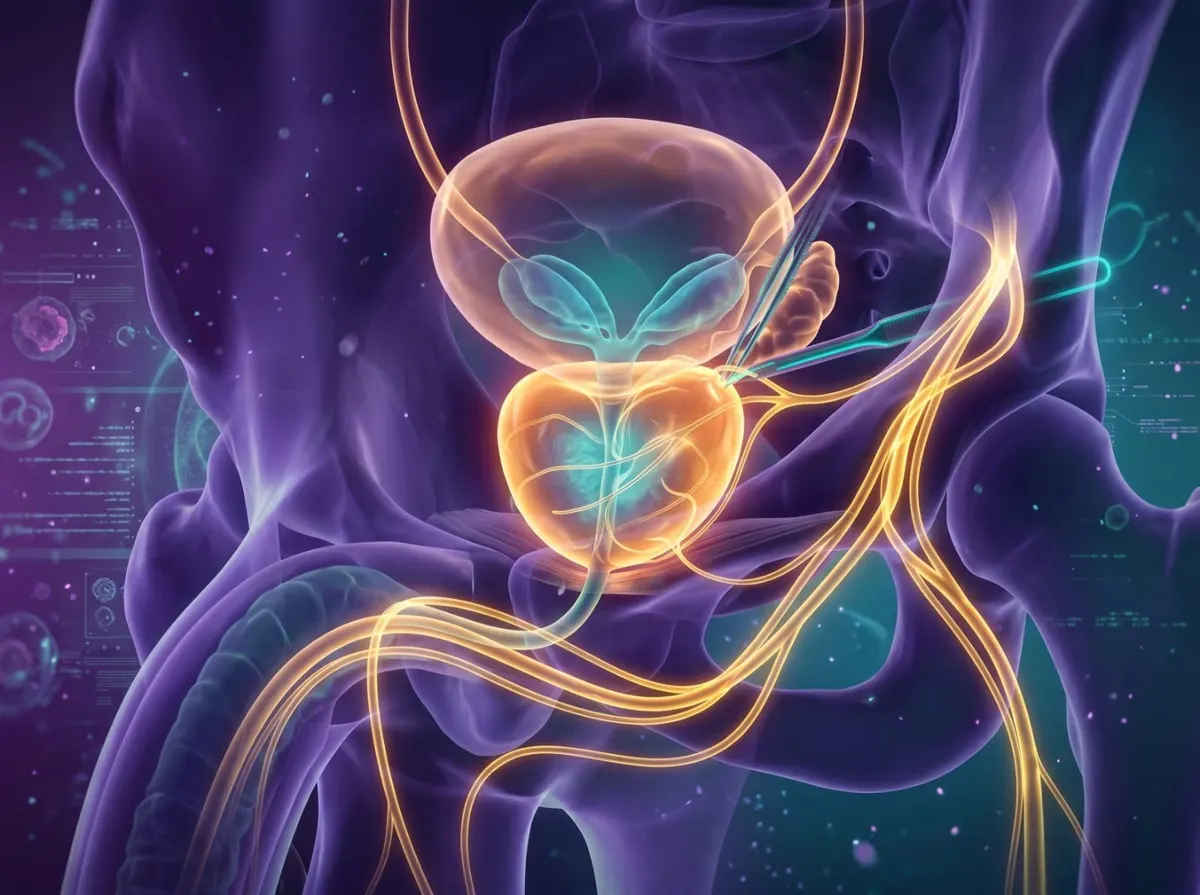
Because the nerves that trigger an erection run in two thin bundles pressed against the sides of the prostate, and removing the gland disturbs them even when they are left in place. These neurovascular bundles carry fine nerve fibres and small blood vessels towards the penis. They are different from the nerves of skin sensation, so feeling in the penis is not lost, and the operation does not remove sexual desire.
To take the prostate out, the surgeon has to peel the bundles off its surface. Stretching, heat and swelling can leave the nerves working poorly for months, even after careful surgery. That is why erectile dysfunction after prostatectomy is the rule in the first weeks, and why the European Association of Urology (EAU) guideline states that 25 to 75% of men have erectile dysfunction after radical prostatectomy. The other side effects of the operation are covered in the overview of side effects of prostate removal.
What is nerve-sparing prostatectomy, and when is it not possible?
Nerve-sparing prostatectomy means leaving one or both nerve bundles in place while the prostate is removed, and it is done only as far as the tumour allows. It can be two-sided (bilateral), one-sided (unilateral) or not done at all. The decision is made for each side separately, from the PSA, the biopsy, the examination and the MRI.
The limit is the capsule, the outer edge of the prostate. A bundle lies directly on it, so when tumour reaches or crosses the capsule on one side, sparing that bundle risks leaving cancer behind. The EAU prostate cancer guideline notes that nerve sparing is more likely to result in positive surgical margins, and it describes studies in which the bundle was not spared on a side where the tumour could be felt or where MRI showed spread beyond the prostate. The same guideline adds that high-risk disease is not in itself a reason to rule nerve sparing out. Cancer control comes first, and the plan can still change during the operation.
What nerve sparing offers
- Better chance of erections. The EAU guideline concludes that nerve sparing is likely to improve erectile function after surgery.
- Earlier urinary control. The same guideline lists early continence among the likely benefits.
- Tablets work better. Erection tablets act through the nerves, so they need at least part of a bundle to respond.
What it costs or cannot do
- Margin risk. Nerve sparing is more likely to result in positive surgical margins, according to the EAU guideline.
- No guarantee. A spared nerve can still work poorly for months, and some men do not recover reliable erections.
- Not always possible. Where tumour reaches the capsule, the bundle on that side is removed.
- The plan can change. What is found during the operation decides, not only the plan made beforehand.
How likely are erections to recover after prostatectomy, and how long does it take?
Many men recover erections, but published rates vary widely, and recovery is slow: it is counted in months and can continue for two years or longer. Before reading any figure, ask what "potent" meant. Studies do not share one definition. One prospective series graded erections on a five-point scale and counted recovery as erections routinely sufficient for intercourse. Trials use questionnaire thresholds: REACTT required 22 or more on the erectile function domain of the International Index of Erectile Function (IIEF-EF), and the Cochrane review accepted 19 or more. Many surgical series also count men who use tablets as potent.
| Question | Finding | Study |
|---|---|---|
| Potency after robotic surgery | 54% to 90% at 12 months; 63% to 94% at 24 months. | Ficarra 2012: systematic review of robotic series |
| Recovery in older series | 58% overall. Single-centre reports 60%, multicentre reports 33%. | Tal 2009: meta-analysis of 22 studies |
| Recovery after 2 years | Further improvement in 8%, 20% and 23% at 3, 4 and 5 years in men with partial erections at 2 years. | Rabbani 2010: prospective series, 136 men |
| Robotic versus open | No significant difference in sexual function scores at 12 weeks or 24 months. | Yaxley 2016, Coughlin 2018: randomised, 326 men |
| Robotic versus open, second trial | Potency 23.9% versus 5.3% at 3 months and 30.6% versus 6.9% at 6 months, in favour of robotic. | Nahas 2024: randomised, 327 men, one hospital |
| Frozen-section guided nerve sparing | Mean IIEF-5 at 12 months 12.7 versus 9.7. | Dinneen 2025: randomised, 381 men operated |
| Tablets as rehabilitation | Target score after stopping: 20.9% daily, 16.9% on demand, 19.1% placebo. | Montorsi 2014 (REACTT): randomised, 423 men |
| Scheduled tablets, pooled | Little or no effect on potency up to 12 months; very low quality evidence. | Philippou 2018: Cochrane review, 8 trials |
Limits: the two reviews pool mostly non-randomised series from experienced centres, with different definitions and questionnaires. In the meta-analysis by Tal, single-centre reports gave 60% and multicentre reports 33%, which suggests that figures from expert centres do not transfer to every hospital.
The EAU guideline on sexual and reproductive health is more sober than most surgical series: it puts recovery of erections without any aid between 20 and 25% in most studies. The gap between that figure and the ranges in the table is largely a matter of definition and of patient selection.
On timing, studies that followed men for 18 months or longer reported slightly more recovery than shorter ones (60% versus 56%, Tal). In a prospective series of 136 men who had not regained reliable erections two years after two-sided nerve-sparing open surgery, improvement continued for some: among those with partial erections at two years, 8%, 20% and 23% had improved further at 3, 4 and 5 years. Early weakness therefore does not predict the final result.
What predicts recovery of erections?
Age, the quality of erections before surgery, other illnesses and how much of the nerve bundles could be spared. These four were the most relevant predictors in the systematic review of robotic series (Ficarra, 2012).
- Age. In the meta-analysis by Tal, men under 60 recovered more often than men of 60 or older (77% versus 61%).
- Erections before surgery. The EAU guideline names age and function before the operation as important predictors. Erections that were already weak rarely improve after surgery.
- Extent of nerve sparing. Two-sided sparing gives the nerves the most room to recover, one-sided less, and none the least.
- Other illnesses. The review found that a higher burden of other illnesses lowers the chance. Diabetes, vascular disease and smoking affect erections in general, so controlling them is part of preparation.
- The surgeon. The EAU guideline states that the surgeon's experience clearly affects erectile outcome, whatever the technique.
None of these factors guarantees a result in an individual man.
Does robotic surgery protect erections better than open surgery?
Not clearly: of two randomised trials, one found no significant difference in sexual function and the other found earlier recovery with the robot. In the first trial, from one hospital in Brisbane, 326 men aged 35 to 70 were assigned to one of the two operations. At 12 weeks the sexual function score on the EPIC questionnaire was 38.90 after robotic and 35.00 after open surgery (p=0.18). At 24 months it was 45.70 and 46.90.
A second randomised trial, from one cancer centre in São Paulo (Nahas and colleagues, 2024), operated on 327 men. Sexual function scores were higher after robotic surgery up to 12 months, and the potency rate was higher at 3 months (23.9% versus 5.3%) and at 6 months (30.6% versus 6.9%). Even in the robotic group, most men had not recovered erections by 6 months.
Non-randomised comparisons also favour the robot. A pooled analysis of such studies found better 12-month potency after robotic surgery (odds ratio 2.84), and a prospective non-randomised study from 14 centres, cited in the EAU guideline, reported erectile dysfunction in 70.4% after robotic and 74.7% after open surgery. In studies of this kind, patients and surgeons differ between the groups, so the difference cannot be credited to the robot alone.
The Brisbane authors concluded that the benefits of the robotic approach are largely those of a minimally invasive operation, and advised patients to choose an experienced surgeon rather than a technique. Prof. Dr. Mutlu Ateş operates with the da Vinci Xi system at Antalya American Hospital; the robot is a tool for precise dissection, not a promise about erections.
What did the NeuroSAFE PROOF trial show about frozen-section guided nerve sparing?
In this randomised trial, checking the edge of the prostate under the microscope during the operation led to better erection scores at 12 months than standard planning. With NeuroSAFE, the bundles are spared first; the side of the removed prostate that faced each bundle is then examined as a frozen section while the patient is still asleep. If tumour reaches the edge, the bundle on that side is removed.
NeuroSAFE PROOF was run in five National Health Service hospitals in the United Kingdom. Of 407 men recruited, all with good erections beforehand, 381 had robotic surgery. At 12 months the mean IIEF-5 score was 12.7 with NeuroSAFE and 9.7 with standard surgery (adjusted difference 3.18 points). Urinary continence scores were better at 3 months and no different at 6 months. Serious adverse events occurred in 3% of each group. The gain was larger in men who would not otherwise have had two-sided nerve sparing.
Limits: follow-up was about 12 months, so the trial does not answer whether long-term cancer control is the same. Surgeons knew the group, patients did not. Men entered the trial with a score of 22 or more on the first five IIEF items, and the group averages at 12 months were 12.7 and 9.7, so the method improved the odds without restoring earlier function for the average man.
The method needs a pathology team organised for it during surgery and is not available in every hospital. It is reported here as study evidence; whether it is offered is a question to put to the hospital where you plan to have surgery.
What is penile rehabilitation, and does it work?
Penile rehabilitation means starting erection treatment early after surgery, usually tablets, with the aim of protecting the tissue while the nerves recover. It helps erections during treatment, but trials have not shown that it brings back more unassisted erections.
The clearest test is REACTT, a randomised, placebo-controlled trial in 423 men aged 68 or younger with normal erections before two-sided nerve-sparing surgery. They took tadalafil 5 mg daily, tadalafil 20 mg on demand, or placebo for 9 months, then stopped all tablets for 6 weeks. After that pause, 20.9%, 16.9% and 19.1% reached the target score: no difference. While tablets were being taken, erections were better with daily tadalafil than with placebo, and loss of penile length at 9 months was smaller (a difference of 4.1 mm).
A Cochrane review of eight randomised trials with 1,699 participants reached the same conclusion: scheduled tablets may have little or no effect on potency up to 12 months compared with placebo or no treatment, the quality of the evidence was very low, and no data beyond 12 months were found. The EAU guideline therefore advises doctors to tell patients that the data are inadequate to support any specific regimen, while still recommending (weak recommendation) that erection treatment starts at the earliest opportunity. In practice, tablets are worth using because they help now, not because they are proven to change the final outcome. They must not be combined with nitrate heart medicines, so a doctor has to check your medication first.
What can be done when tablets do not work after prostatectomy?
There are three further steps: a vacuum device, injections into the penis, and a penile implant. Each can produce an erection that does not depend on the nerves. This matters most after surgery without nerve sparing. The table follows the EAU guideline on sexual and reproductive health.
| Treatment | EAU guideline position | Reported results |
|---|---|---|
| Tablets (PDE5 inhibitors) | First-line treatment (strong) | Considered first-line after nerve-sparing surgery. |
| Vacuum device | For informed men who want a drug-free option (weak) | Efficacy as high as 90%; satisfaction 27% to 94%; long-term use falls to 50 to 64% after two years. |
| Injections (alprostadil) | Alternative first-line or second-line (strong) | Efficacy above 70%; satisfaction 87 to 93.5% in patients; drop-out 41 to 68%. |
| Penile implant | If other treatments fail or by patient preference (strong) | Satisfaction 92 to 100% in patients, 91 to 95% in partners; mechanical failure below 5% after five years; infection 2 to 3%. |
Limits: these figures describe men with erectile dysfunction from any cause, not only after prostatectomy, and come mostly from non-randomised series.
With a vacuum device the ring at the base has to be removed within 30 minutes, and the device is contraindicated in men with bleeding disorders or on anticoagulant therapy. With injections, the guideline lists prolonged erections (5%), priapism (1%) and fibrosis (2%). An implant is an operation and is not reversible, so it is usually discussed once recovery has had time to declare itself.
What else changes in sex after prostatectomy, and where does the partner fit in?
Orgasm remains possible but becomes dry, and some men notice leakage of urine at orgasm or a shorter penis. No semen is produced, because the prostate and the seminal vesicles are removed. In a systematic review of 43 articles (Frey, 2014), leakage of urine at orgasm or during arousal was reported at least a few times by 20 to 93% of men, altered orgasm by approximately 80%, pain at orgasm by 3% to 19%, and shortening by 15 to 68%. The ranges are wide because the studies differed, and the review found that these effects lessen with time. Leakage in daily life is covered in the article on incontinence after prostate surgery.
Sex after prostatectomy is a matter for two people. The EAU guideline gives a strong recommendation to discuss sexual changes other than erections with men treated for prostate cancer. It also states that focused psychosexual counselling may improve sexual well-being in both patients and partners, and its recommendation on psychological therapy asks that the partner is included.
Which questions should you ask, and what changes if you travel for surgery?
Ask what is planned for each nerve bundle, and who will look after erection recovery once you are home.
- Does my MRI or biopsy show tumour near the capsule, and on which side?
- Do you plan to spare the nerves on both sides, on one side, or not at all, and why?
- What would make you change that plan during the operation?
- Given my age and my erections today, what is a realistic expectation at one and at two years?
- When should I start tablets, and what is the next step if they do not work?
- Will the operation note and the pathology report state what was done on each side?
If you travel from abroad: reports are reviewed first by WhatsApp or email, and most patients plan 5 to 7 days in Antalya in total. Recovery of erections happens afterwards, at home, over many months. In most countries erection tablets and injections need a prescription, so arrange before you travel a urologist or family doctor at home who will prescribe and review them. Ask for a medical letter that states the nerve sparing on each side and the final pathology. More on the operation itself is on the prostate cancer page.
This article gives general information and does not replace an assessment of your own scans and results. Treatment is decided individually.