
Why does urine leak after prostate removal?
Because the operation removes part of the system that holds urine in, and the muscle that remains needs time to take over. The prostate sits below the bladder and surrounds the first part of the urethra. In radical prostatectomy the whole gland is removed and the bladder is joined directly to the urethra.
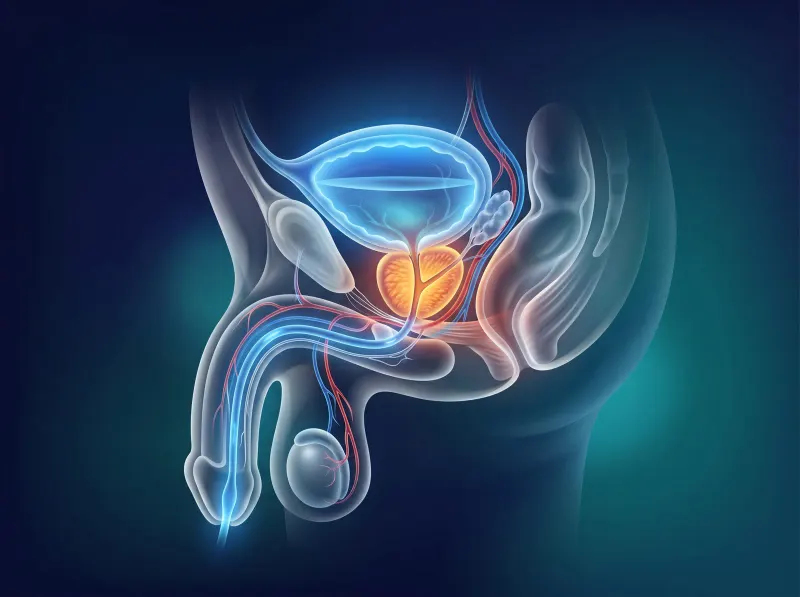
Before surgery, three structures hold urine back: the bladder neck, the prostate itself and the external sphincter, a ring of muscle just below the prostate. Afterwards, the external sphincter and the pelvic floor muscles around it do most of the work alone. The sphincter may be bruised or stretched, the urethra is slightly shorter, and the new join needs to heal. The European Association of Urology (EAU) guideline describes keeping this sphincter intact as critical for continence.
The usual result is stress incontinence: drops or small spurts when you cough, laugh, lift or stand up, often worse late in the day when the muscle is tired. Some men also feel urgency, a sudden need to pass urine, because the bladder is irritable after surgery. Leakage is one of several possible effects of the operation. The others are covered in side effects of prostate removal and erections after prostatectomy.
How long does incontinence last after prostate surgery?
Most of the recovery happens in the first 6 months and continues up to 12 months; a minority of men still leak after that. The percentage you read depends heavily on what a study counts as "continent": no pad at all, one safety pad, or no leakage whatsoever.
| Time after surgery | Finding and definition | Study |
|---|---|---|
| 1 month | 8% continent without formal training, 19% with it (pad tests, open surgery) | Filocamo 2005: randomised, 300 men |
| 12 weeks | Urinary function score 82.50 after robotic and 83.80 after open surgery (higher is better) | Yaxley 2016: randomised, 326 men |
| 6 months | Score 88.68 robotic, 88.45 open | Coughlin 2018: same trial |
| 6 months | 65% continent without formal training, 94.6% with it | Filocamo 2005 |
| 12 months | Score 90.76 robotic, 91.53 open | Coughlin 2018 |
| 12 months | Incontinent: mean 16% if continent means no pad; mean 9% if one safety pad is allowed | Ficarra 2012: review of 51 articles |
| 12 months | 21.3% (robotic) and 20.2% (open) changed a pad at least once in 24 hours | Haglind 2015 (LAPPRO): 14 centres, not randomised |
| 7 to 12 years | 18 to 24% reported leakage requiring pads | ProtecT trial, cited in EAU guideline |
Limits: definitions differ between studies, so the rows cannot be added up or compared directly. The review pooled mostly non-randomised series from experienced centres. The Filocamo trial was done with open surgery at one centre, and its abstract does not give the pad definition.
The two definitions give different pictures of the same men. In a systematic review of 51 articles on robotic surgery, incontinence at 12 months ranged from 4% to 31% (mean 16%) when continent meant no pad, and from 8% to 11% (mean 9%) when one safety pad was allowed. When you compare surgeons or hospitals, ask which definition is behind the number.
Leakage does not always disappear completely. In the randomised ProtecT trial, 18 to 24% of men in the prostatectomy group reported leakage requiring pads between 7 and 12 years, compared with 9 to 11% of men on active monitoring, as cited in the EAU guideline. The figure in the monitoring group shows that some leakage in later life comes with age and not with surgery.
Who recovers urinary control more slowly?
Older men, heavier men, men with other illnesses or urinary symptoms before surgery, and men who have had a previous prostate operation tend to recover more slowly. These factors shift the odds. They do not decide the outcome for one person.
| Factor | What the evidence says | Source |
|---|---|---|
| Age | Among the most relevant predictors of leakage before surgery | Ficarra 2012 review |
| Body weight | Body mass index is a predictor; obesity is linked to worse continence (relative risk 1.17) | Ficarra 2012; EAU guideline |
| Other illnesses | A higher comorbidity index predicts leakage | Ficarra 2012 review |
| Prostate size and urinary symptoms | Prostate volume and urinary symptoms before surgery are both predictors | Ficarra 2012 review |
| Previous TURP | Lower odds of continence recovery (odds ratio 0.60) | EAU guideline |
| Urethral length on MRI | Every extra millimetre of membranous urethra improves early return to continence | EAU guideline |
| Nerve sparing | Likely to improve early continence; bilateral nerve sparing: relative risk 1.08 at 12 months | EAU guideline |
| Surgeon experience | Influences how often leakage is reported | Ficarra 2012 review |
Limits: these predictors come from observational studies and meta-analyses of such studies. They are associations, and several of them occur together in the same patient.
Two of these can be assessed before surgery: the length of the membranous urethra is visible on the MRI you have probably already had, and weight can be worked on while the operation is being planned. Whether the nerves can be spared depends on where the tumour lies, which is explained on the prostate cancer page.
Does the surgical technique matter for continence?
Less than is often claimed: the two randomised trials of robotic versus open surgery disagree, and no technique guarantees dryness. In the Brisbane trial, 326 men at one hospital were randomly assigned to robot-assisted or open radical prostatectomy. Urinary function scores (a questionnaire in which higher is better) did not differ significantly at 12 weeks (82.50 versus 83.80), 6 months (88.68 versus 88.45), 12 months (90.76 versus 91.53) or 24 months (91.33 versus 90.86). The authors advised patients to choose an experienced surgeon they trust, and to see the benefit of the robot as largely related to its less invasive nature.
A Swedish study in 14 centres (LAPPRO, prospective but not randomised) pointed the same way: at 12 months, 21.3% of men were incontinent after robotic and 20.2% after open surgery, defined as changing a pad at least once in 24 hours. Pooled comparative studies in the 2012 review did favour robotic surgery at 12 months (odds ratio 1.53), and a second single-centre randomised trial of 327 men in São Paulo (Nahas and colleagues, 2024) found higher continence after robotic surgery at 3 months (80.5% versus 64.7%), 6 months (90.1% versus 81.6%) and 18 months (95.4% versus 78.8%). The answer depends on the study, the surgeons in it and the definition used.
Retzius-sparing surgery. Here the prostate is reached from behind the bladder and the tissue in front of it is left untouched. A 2025 meta-analysis of comparative studies found better continence at every time point from catheter removal to 12 months. When only randomised trials were pooled, the rates at 6 months (odds ratio 1.99, 95% CI 0.90 to 4.42) and at 12 months (odds ratio 1.36, 95% CI 0.43 to 4.31) overlapped. The authors rated the evidence as mainly low to moderate in quality. The EAU guideline adds that higher positive surgical margin rates have been reported consistently with this approach, without a significant difference in PSA recurrence. In short: probably earlier dryness, no proven difference at one year, and a possible cost in margins.
Posterior reconstruction. The tissue layers behind the urethra are stitched together before the bladder is joined to it. In the 2012 review this was linked to a small advantage at 1 month, and only a complete reconstruction (back and front) showed a significant advantage at 3 months. The EAU guideline notes that two trials found no significant improvement, and concludes that reconstruction may bring continence back earlier but makes no long-term difference.
These are findings from published studies. They are not a description of the technique used at this practice.
Do pelvic floor exercises help, and what does the evidence really show?
They can bring control back sooner; whether they change the final result at 12 months is not proven. At this practice the view is that pelvic floor physiotherapy after catheter removal can contribute greatly to the recovery of urinary control. The trials support that for the speed of recovery, and they are less clear about the end point.
| Study | Design | Result |
|---|---|---|
| Filocamo 2005 | Randomised, 300 men after open surgery: structured training from catheter removal versus no formal instruction | Continent at 1 month: 19% vs 8%. At 6 months: 94.6% vs 65%. At one year, 93.3% of all men. |
| Glazener 2011 (MAPS) | Randomised, men still leaking 6 weeks after surgery: four therapist sessions over 3 months versus standard care with lifestyle advice | Any leakage at 12 months: 76% vs 77%. No significant difference. |
| Johnson 2023 (Cochrane) | Systematic review: 25 trials, 3079 men | Combined conservative treatments: little difference in cure or improvement at 6 to 12 months (risk ratio 0.97). Value remains uncertain. |
Limits: the Cochrane authors describe the trials as typically small and methodologically flawed, with no standard training technique. In MAPS the comparison group also received information on exercises, so the trial tested extra therapist sessions, not exercise against no exercise.
Read together, the picture is consistent. Men who are taught the exercises properly from the day the catheter comes out get dry earlier. Men who still leak at 6 weeks and then add therapist sessions to written advice do not end up drier at 12 months than men who train by themselves. The EAU guideline states that uncertainty about the value of conservative treatments remains, and at the same time gives a strong recommendation to offer rehabilitation that addresses incontinence after any radical treatment.
What the trials support
- Earlier control. In a randomised trial of 300 men, 94.6% were continent at 6 months with structured training and 65% without it.
- A head start in the first month. In the same trial, 19% versus 8% were continent at 1 month.
- Little to lose. No adverse effects were reported in the MAPS trial.
What they do not show
- A better final result. In MAPS, 76% with therapist sessions and 77% without still reported some leakage at 12 months.
- That more sessions are better. Where information on exercises is widely available, one-to-one therapy added little in MAPS.
- Certainty. The 2023 Cochrane review of 25 trials concludes that the value of conservative treatment remains uncertain.
- A guarantee. Some men train correctly and still need further treatment.
What should you do in the first weeks after the catheter comes out?
Expect leakage, protect the skin, drink normally and start the exercises once your surgeon agrees. The first days are usually the wettest, and that says little about where you will be in three months.
- Pads. Use pads made for men and change them when wet. Count the pads you use each day: the trend over weeks is more useful than any single day.
- Fluids. Do not drink less in order to leak less. Concentrated urine irritates the bladder. Spread drinks over the day and take less in the evening.
- Caffeine and alcohol. Coffee, tea, cola, fizzy drinks and alcohol can increase urgency. Reduce them for a few weeks and see whether it helps.
- Timing. Pass urine at regular intervals and avoid going "just in case" every few minutes, which trains the bladder to hold less.
- Exercises. Do not train while the catheter is in. Afterwards, tighten the muscle you would use to stop urine and wind, lift, hold, then release fully. Mix short strong squeezes with longer holds, and squeeze just before you cough, lift or stand up.
- Daily life. Walk every day, avoid heavy lifting in the early weeks and prevent constipation, since straining pushes on the pelvic floor.
A physiotherapist who treats men after prostate surgery can check that you are using the right muscle. Many men tighten the abdomen or the buttocks instead.
What if leakage continues beyond 12 months?
Then it is unlikely to resolve by training alone, and there are effective operations. The first step is an assessment: how much you leak, when, whether the bladder empties, and whether a narrowing at the join is involved.
- Duloxetine. In a placebo-controlled trial of 31 men at one centre, the frequency of leakage episodes fell by 52.2% with duloxetine over 3 months and rose by 19.0% with placebo. The trial was small and described as preliminary. The medicine is not specifically licensed for this use in men, and side effects such as nausea and tiredness are known with it.
- Male sling. A tape placed under the urethra through small incisions supports it. There is nothing to operate by hand.
- Artificial urinary sphincter. A fluid-filled cuff around the urethra is opened by squeezing a small pump in the scrotum. It is a mechanical device and may need revision over the years.
The randomised MASTER trial compared the two operations in 380 men at 27 centres in the United Kingdom. With a strict questionnaire definition, 87.0% of men after a sling and 84.2% after a sphincter were still incontinent at 12 months, so the sling was not inferior. Symptom scores roughly halved in both groups (from 16.1 to 8.7 and from 16.4 to 7.5), satisfaction was high, and serious adverse events were few (6 and 13). Where other outcomes differed significantly, they favoured the sphincter. The EAU guideline, citing a meta-analysis, gives an overall cure rate of approximately 60% for these operations.
When should you seek help early?
Contact your urologist without waiting for the next appointment if urine stops flowing, if you have signs of infection, or if the stream becomes steadily weaker.
- Retention. You cannot pass urine, or only dribble, with a painful full feeling in the lower abdomen. This needs attention the same day.
- Infection. Fever, chills, burning, cloudy or foul-smelling urine, or leakage that suddenly gets worse after it had been improving.
- Narrowing at the join. A stream that was good and then becomes thin and slow over weeks, with straining or a feeling of incomplete emptying. Scar tissue where the bladder meets the urethra can cause this and can be treated.
- Blood. Visible blood with clots, or bleeding that does not settle.
Leakage that is slowly improving is not on this list. It needs time, training and a review at the planned visits.
Which questions should you ask your surgeon?
Ask for figures with their definition, and ask what happens if recovery is slow.
- How do you define continent when you quote your results: no pad, or one safety pad?
- Do my age, weight, prostate size or previous prostate surgery change what I should expect?
- Can the nerves be spared in my case, on one side or both?
- When does the catheter come out, and when may I start pelvic floor exercises?
- Should I see a pelvic floor physiotherapist before the operation to learn the technique?
- At what point would you investigate leakage further, and who would treat it?
What changes if you travel abroad for the operation?
The recovery of continence happens at home, so the support for it should be arranged at home before you fly. Prof. Dr. Mutlu Ateş operates at Antalya American Hospital with the da Vinci Xi system. Reports are reviewed first by WhatsApp or email, and for most operations patients plan 5 to 7 days in Antalya in total.
After prostatectomy the catheter usually stays 7 to 10 days. You can fly home with it: a flight report is prepared, and your family doctor or your own urologist removes it at home with a medical letter. Staying in Antalya until removal is also possible.
Because training starts when the catheter comes out, book a pelvic floor physiotherapist near your home before you travel, ideally with one visit before surgery to learn the technique. Agree with your own urologist who will remove the catheter and who will see you if leakage is slow to improve. The first PSA test is due 4 to 6 weeks after surgery. More on planning the journey is in prostate surgery in Turkey.
This article gives general information and does not replace an assessment of your own scans and results. Treatment is decided individually.