
Which side effects of prostate removal are common, and which are rare?
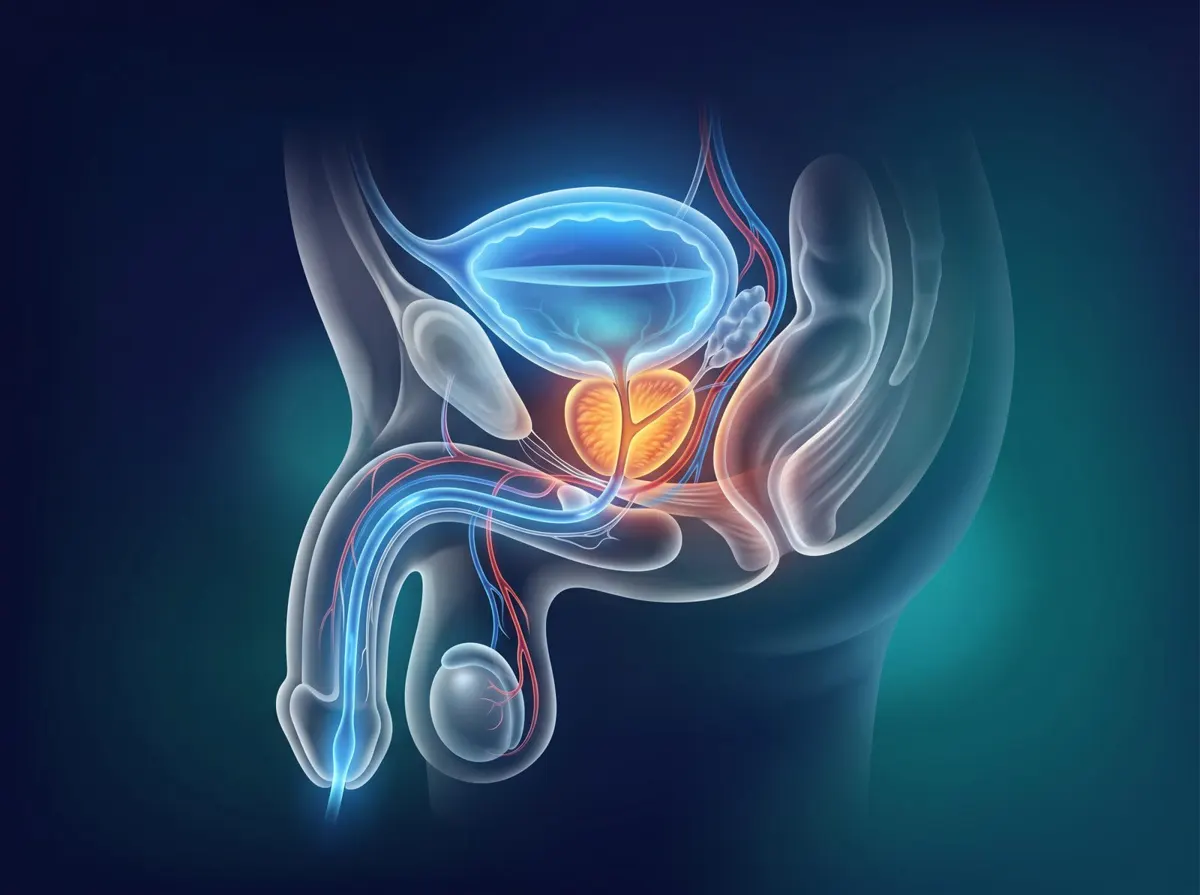
Urine leakage and erection problems are common, the loss of ejaculation is certain, and serious surgical complications are uncommon. Radical prostatectomy removes the whole prostate and the seminal vesicles, then joins the bladder to the urethra. The side effects follow from that anatomy: the urinary sphincter lies directly below the prostate, and the nerves for erection run along its sides.
| Side effect | How often | How long it usually lasts |
|---|---|---|
| Urine leakage | 4% to 31% still leaking at 12 months in robotic series (mean 16%, no-pad definition) | Worst in the first weeks, improves over months, lasting in a minority |
| Weaker erections | Potency at 12 months 54% to 90% in robotic series; lower in the ProtecT trial | Recovery is slow and continues into the second year |
| Dry orgasm, infertility | Every man | Permanent |
| Urine at orgasm | 21 to 38% across studies | Varies |
| Penis seems shorter | 0 to 55% across studies | Not well studied |
| Inguinal hernia | 7.9% after robotic, 13.7% after open surgery | Stays until repaired |
| Narrowing of the join | 4.8% in a registry of 17,904 men | Appears at a median of 3.4 months; treatable, may return |
| Blood clot | 0.2 to 0.9% up to 3.9 to 15.7%, by type of operation | Risk estimated for the first 4 weeks |
| Any complication (robotic) | Mean 9%, mostly low grade | First weeks |
Limits: the rows come from different studies with different definitions and follow-up, so they cannot be compared with one another. Most figures are pooled from non-randomised series. Your own risk depends on age, function before surgery, the extent of the tumour and whether the nerves can be spared.
The sections below take each group in turn. This page is an overview; leakage and erections each have their own detailed article.
How common is urine leakage after prostate removal, and does it stop?
Leakage is expected when the catheter comes out, it improves over the following months in most men, and a minority still use pads years later. It is usually stress leakage: a few drops or more when you cough, lift or stand up.
A systematic review of 51 reports on robotic prostatectomy (Ficarra and colleagues, 2012) found that 4% to 31% of men were still incontinent at 12 months, with a mean of 16%, when continence meant no pad at all. When a single safety pad was accepted, the range was 8% to 11%, with a mean of 9%. Older age, higher body mass index, other illnesses, urinary symptoms before surgery and a larger prostate predicted leakage. Most of these reports were non-randomised series, and the wide range shows how much the definition matters.
Long-term figures from a randomised trial are less favourable. In ProtecT, 18 to 24% of men in the prostatectomy group used pads between 7 and 12 years after treatment.
Pelvic floor physiotherapy after catheter removal can contribute greatly to the recovery of urinary control. When bothersome leakage persists, further treatments exist. The timeline, exercises and options are set out in incontinence after prostate surgery.
Will erections come back after prostatectomy?
Sometimes fully, often partly, and in some men not without treatment: it depends mainly on age, erections before surgery and whether the nerves could be spared. Nerve sparing is possible only when the position of the tumour allows it, because cancer control comes first.
In a systematic review of robotic prostatectomy series (Ficarra and colleagues, 2012), potency rates ranged from 54% to 90% at 12 months and from 63% to 94% at 24 months. These were largely case series from experienced centres, and recovery was predicted by age, potency before surgery, other illnesses and the extent of nerve sparing. In the randomised ProtecT trial the picture was more sober: 18% of men in the prostatectomy group reported erections sufficient for intercourse at 7 years.
The gap between those figures is the honest answer. Results in selected men with good erections and full nerve sparing do not carry over to every patient. Desire is not removed by the operation, and treatments for erections are available. Details are in erections after prostatectomy.
Which changes are men often not told about?
Four: orgasm without semen, urine leakage at orgasm, a penis that seems shorter, and a higher chance of a groin hernia.
- Dry orgasm and infertility. The prostate and seminal vesicles make most of the semen, and the sperm ducts are divided during the operation. Orgasm is still felt, but no fluid comes out. This applies to every man and is permanent, so natural conception is no longer possible. If you may want children, ask about sperm banking before surgery.
- Urine at orgasm (climacturia). A scoping review of 23 studies (Röscher and colleagues, 2022) found this in 21 to 38% of men after radical prostatectomy, against 4 to 5.2% after radiotherapy. Emptying the bladder beforehand is the usual first advice.
- A penis that seems shorter. In the same review, shortening was reported in 0 to 55% of men across studies of surgery and radiotherapy. The wide range reflects different methods: some studies measured, others asked.
- Inguinal hernia. A meta-analysis of 54 studies with 101,687 patients (Alder and colleagues, 2020) estimated a groin hernia in 13.7% of men after open, 7.5% after laparoscopic and 7.9% after robot-assisted prostatectomy. Where a comparison group existed, the rate was 11.7% after open surgery and 3.3% in untreated men. A hernia shows as a lump or ache in the groin and can be repaired.
Limits: the review found that no validated questionnaire had been used for these sexual side effects, and men in the included studies said they had been inadequately informed. The hernia figures are pooled from observational studies.
What can go wrong in the first weeks after surgery?
Bleeding, infection, blood clots, a collection of lymph fluid, and leakage or later narrowing where the bladder is joined to the urethra. Each is uncommon, and most are treatable. In a systematic review of robotic prostatectomy (Novara and colleagues, 2012), the mean complication rate was 9%, and most complications were of low grade.
- Bleeding. The mean transfusion rate in that review was 2%. Bleeding that needed a second operation was estimated at 0.1 to 1.0% after prostatectomy in a separate meta-analysis (Tikkinen and colleagues, 2018).
- Infection. Urinary infection related to the catheter, or infection of a wound, can occur. No pooled figure is given here because the sources above do not report one.
- Blood clots. A clot in a leg vein can travel to the lung. The same meta-analysis estimated the risk in the 4 weeks after surgery, without preventive drugs, at 0.2 to 0.9% for robotic prostatectomy without lymph node removal, rising to 3.9 to 15.7% for open prostatectomy with extended lymph node removal. This is why early walking matters and why blood thinners are decided individually.
- Lymphocele. This happens only when pelvic lymph nodes are removed. Lymph fluid collects in the pelvis; many collections cause no symptoms, some cause pressure, leg swelling or infection and need drainage. Lymphocele or lymph leakage was recorded in 3.1% in the Novara review.
- Urine leak at the join. Recorded in 1.8%. It is usually managed by leaving the catheter in longer.
- Narrowing of the join later. In a registry of 17,904 men operated on between 1987 and 2013 (Britton and colleagues, 2023), 4.8% developed a narrowing, at a median of 3.4 months. The sign is a weak, slow stream. Of the men treated, 82% had the narrowing stretched through a telescope, and 34% needed retreatment within 1 year.
Limits: reoperation was needed in 1.6% in the Novara review, which pooled series published from 2008 with varied reporting. The clot estimates were rated moderate in quality for prostatectomy. The registry comes from a single institution and covers many years of mostly older operations.
Does robotic surgery reduce side effects compared with open surgery?
For urinary control and erections, the two randomised trials do not agree: one found no difference, the other favoured the robot. The measured advantages of the robot are less blood loss and, in non-randomised data, fewer hernias and fewer narrowings. The first trial was done at one hospital in Brisbane: 326 men aged 35 to 70 were randomly assigned to robot-assisted or open prostatectomy, and results were reported at 12 weeks (Yaxley and colleagues, 2016) and at 24 months (Coughlin and colleagues, 2018).
| Question | Finding | Study |
|---|---|---|
| Urinary function at 24 months | Score 91.33 robotic, 90.86 open: no significant difference | Coughlin 2018: randomised, 326 men, one hospital |
| Sexual function at 24 months | EPIC score 45.70 robotic, 46.90 open: no significant difference | Coughlin 2018: same trial |
| Continence and potency, second trial | Continence 95.4% robotic, 78.8% open at 18 months. Potency 30.6% and 6.9% at 6 months. | Nahas 2024: randomised, 327 men, one hospital |
| Complications after surgery | 4% robotic, 9% open (p=0.052). Adverse events during surgery: 2% and 8% | Yaxley 2016: same trial, early results |
| Blood loss and transfusion | Lower with robotic than with open surgery | Novara 2012: pooled comparative studies |
| Continence and potency at 12 months | Better after robotic surgery (odds ratios 1.53 and 2.84) | Ficarra 2012: pooled comparative studies, not randomised |
| Inguinal hernia | 7.9% robotic, 13.7% open | Alder 2020: meta-analysis of 54 studies |
| Narrowing of the join | Lower odds with the robotic approach (odds ratio 0.39) | Britton 2023: registry of 17,904 men |
Limits: both randomised trials were single-centre, and the Brisbane authors advised caution about their cancer outcomes. The pooled comparisons that favour the robot are non-randomised, so differences between surgeons and patients may explain part of them.
A second randomised trial, from one cancer centre in São Paulo (Nahas and colleagues, 2024), operated on 327 men. Continence was higher after robotic surgery at 3 months (80.5% versus 64.7%), 6 months (90.1% versus 81.6%) and 18 months (95.4% versus 78.8%), and the potency rate was higher at 3 months (23.9% versus 5.3%) and 6 months (30.6% versus 6.9%). Complications within 90 days did not differ significantly (11.1% versus 17.3%). The two trials had different surgeons, definitions and questionnaires, which may explain why they disagree.
What the robot changes
- Less blood loss. Blood loss and transfusion were lower with robotic than with open surgery in pooled comparative studies.
- Fewer early complications in the Brisbane trial. 4% against 9% after surgery, a difference at the edge of statistical significance (p=0.052).
- Fewer hernias and narrowings in non-randomised data. Hernia in 7.9% against 13.7%, and lower odds of narrowing at the join.
What is not proven, or does not change
- Urinary control: not settled. The same at 24 months in the Brisbane trial, better with the robot at 18 months in the São Paulo trial.
- Erections: not settled. The same at 24 months in the Brisbane trial, better with the robot in the first 12 months in the São Paulo trial.
- Dry orgasm and infertility. Certain with every technique.
- The surgeon still matters. The trial authors advised choosing an experienced surgeon rather than an approach.
The Brisbane authors encouraged patients to choose an experienced surgeon they trust rather than a particular approach. Prof. Dr. Mutlu Ateş operates at Antalya American Hospital with the da Vinci Xi system.
How does surgery compare with radiotherapy and active monitoring?
Surgery causes more urine leakage and more erection problems, radiotherapy causes more bowel problems and night-time urination, and monitoring avoids both until treatment becomes necessary. The evidence is the ProtecT trial, in which 1643 men with localised prostate cancer were randomly assigned to prostatectomy, radiotherapy with hormone treatment, or active monitoring, and completed questionnaires for 12 years.
| Outcome | After surgery | After radiotherapy or monitoring |
|---|---|---|
| Pads for leakage, years 7 to 12 | 18 to 24% | Radiotherapy 3 to 8%; monitoring 9 to 11% |
| Erections sufficient for intercourse, year 7 | 18% | Radiotherapy 27%; monitoring 30% |
| Erections, year 12 | Low | Low in all groups |
| Passing urine at least twice a night, year 12 | 34% | Radiotherapy 48%; monitoring 47% |
| Faecal leakage, year 12 | 6% | Radiotherapy 12%; monitoring 6% |
Limits: the operations in ProtecT predate the routine use of robotic surgery. Men in the monitoring group who later had surgery or radiotherapy were still counted in the monitoring group.
In the first 6 years, bowel function was worse after radiotherapy at 6 months and then recovered somewhat, except for bloody stools, which became more frequent. General quality of life, anxiety and depression did not differ significantly between the three groups. Side effects are only half of the decision; cancer control for each option is discussed on the prostate cancer page.
What can you do before and after surgery to lower the risks?
You cannot remove the risks, but you can influence several of them.
- Before surgery. Learn pelvic floor exercises while you can still feel the muscles working normally. Stop smoking and, if there is time, lose excess weight: body mass index predicted both leakage and narrowing of the join in the studies above.
- Tell the team everything. List every medicine, especially blood thinners, and every past illness. If the anaesthesia assessment finds a serious undeclared condition, surgery may be postponed.
- Ask about nerve sparing and fertility. Whether one or both nerve bundles can be kept is decided from your biopsy and imaging. Arrange sperm banking beforehand if it matters to you.
- After surgery. Walk early and often to lower the risk of clots. Restart pelvic floor exercises once the catheter is out. Avoid heavy lifting and straining in the first weeks.
- Keep the follow-up. The first PSA is measured 4 to 6 weeks after surgery, then usually every 3 months in the first year: see PSA after prostatectomy. Raise leakage and erection problems at these visits rather than waiting.

When should you call your doctor after going home?
Call the same day for fever, a catheter that stops draining, heavy bleeding, or a wound that turns red and leaks. A swollen calf, chest pain or sudden breathlessness needs emergency care at once.
- Fever or shivering.
- No urine in the catheter bag, or strong lower abdominal pain with the urge to pass urine.
- Bright red urine with clots that does not clear when you drink more.
- Increasing abdominal swelling or pain, or swelling of one leg or the scrotum that keeps growing.
- Later on: a stream that becomes weak and slow, or a new lump in the groin.
Travelling from abroad: the catheter usually stays 7 to 10 days. You can fly home with it; a flight report is prepared, and your family doctor or own urologist removes it with a medical letter. Staying in Antalya until removal is also possible. Plan 5 to 7 days in total, and arrange a doctor at home before you travel.
Which questions should you ask your surgeon?
Ask for your own expected figures, not the average ones.
- Can the nerves be spared on one side or both in my case, and what decides that?
- Given my age and current function, what are my chances of being pad-free and of having usable erections at one year?
- Will lymph nodes be removed, and how does that change my risk of clots and lymphocele?
- How do you prevent blood clots, and for how long?
- Who do I contact after I go home, and who removes the catheter?
- What help is offered if leakage or erection problems persist?
This article gives general information and does not replace an assessment of your own scans and results. Treatment is decided individually.