Home/Male pelvic floor rehabilitation
Before and after prostate surgery · Pelvic floor muscle training
Male pelvic floor rehabilitation
After the prostate is removed, urinary control depends on the sphincter muscle below it and on the pelvic floor around it. Training these muscles, learned before the operation and resumed once the catheter is out, is the first step in treating leakage after prostate surgery. The trials show that it brings control back sooner. They are less clear about the result at one year.
 Written and reviewed by Prof. Dr. Mutlu Ateş, urologist, Antalya American Hospital. More than 1,000 robotic operations. Published 18 November 2026.
In short
What to know first
- Radical prostatectomy removes the prostate and joins the bladder to the urethra again. The bladder neck and the prostate no longer help to hold urine, so the external sphincter and the pelvic floor do this work alone.
- The European Association of Urology guideline advises offering pelvic floor muscle training to men having radical prostatectomy, to speed the recovery of continence.
- In a meta-analysis of 15 randomised trials, training after surgery lowered the odds of leakage at 1, 3 and 6 months. At 12 months the difference was no longer significant.
- Starting before the operation is a good way to learn the technique. Whether it adds to the result is not settled.
Anatomy
The muscles that take over
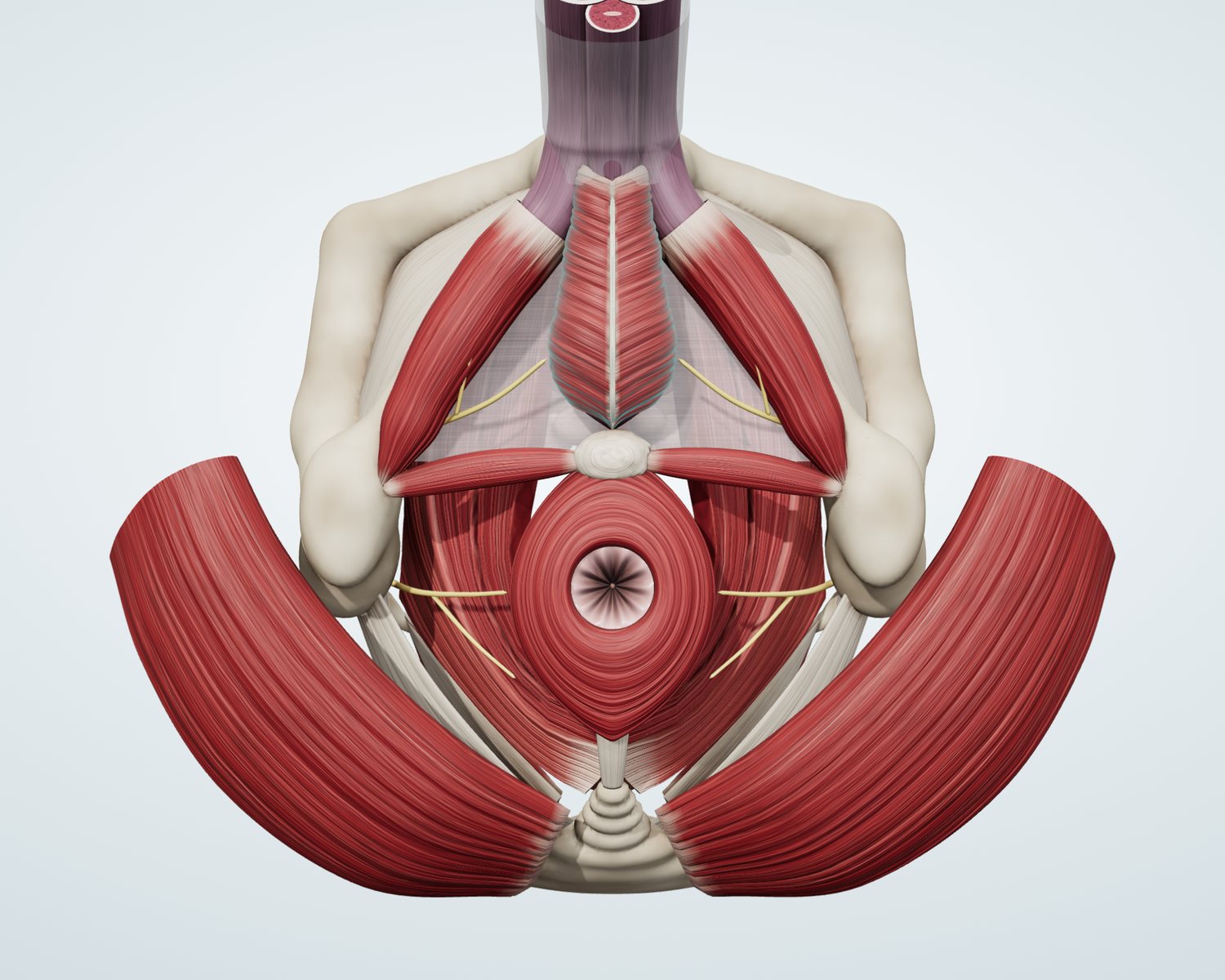
Before surgery three structures hold urine back: the bladder neck, the prostate and the external sphincter. After surgery the sphincter and the pelvic floor remain, and they are often weak or bruised at first.
External urethral sphincter
A ring of striated muscle around the urethra, just below where the prostate was. After the operation it is the main closing mechanism, and it is the muscle the training is aimed at.
Levator ani
The sheet of muscle that closes the pelvis from below, with the pubococcygeus in front and the puborectalis sling around the bowel. It supports the bladder and lifts when it contracts.
Muscles at the root of the penis
The bulbospongiosus empties the last drops from the urethra after urination. With the ischiocavernosus it raises the pressure in the erectile tissue during the rigid phase of an erection.
The new join
The bladder neck is sewn to the urethra above the sphincter (vesicourethral anastomosis). Continence then depends on the muscles below this join, which is why they are trained.
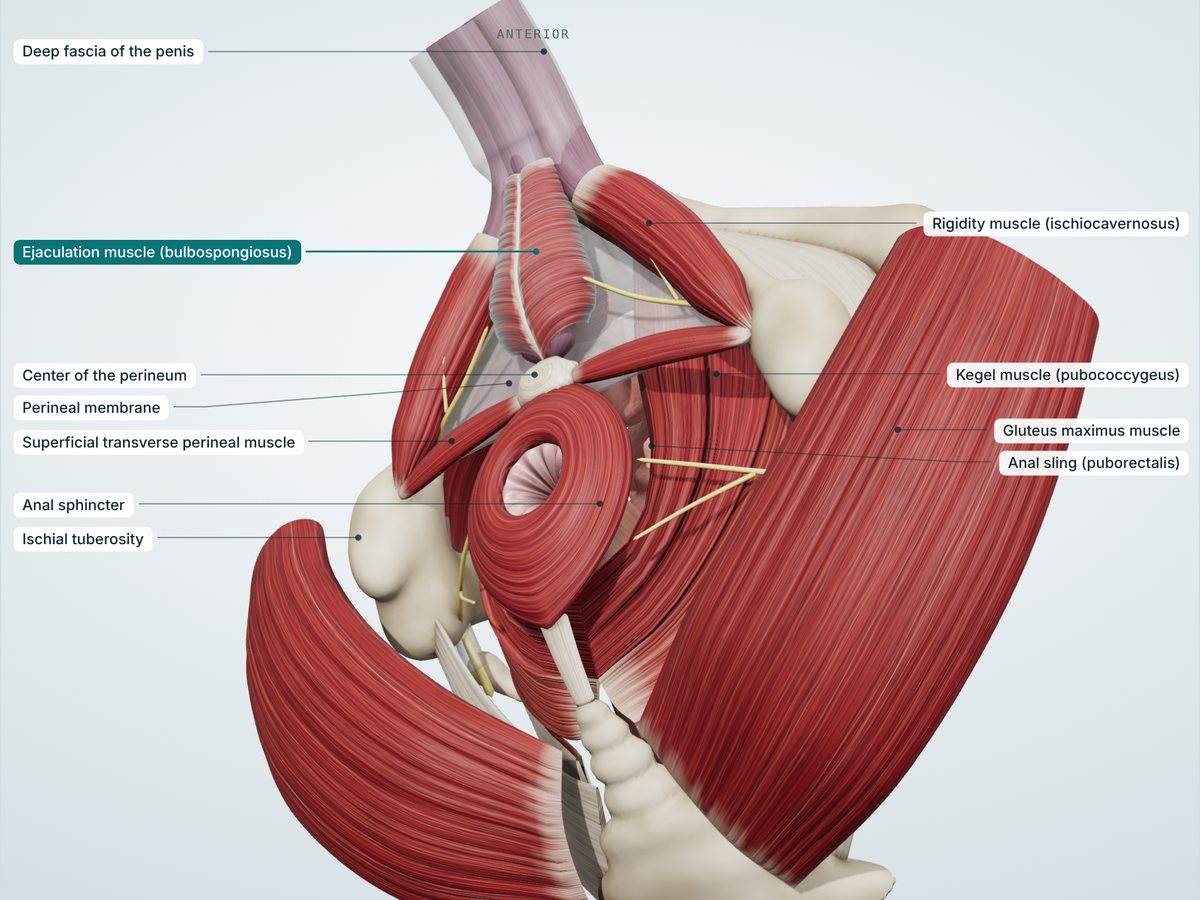
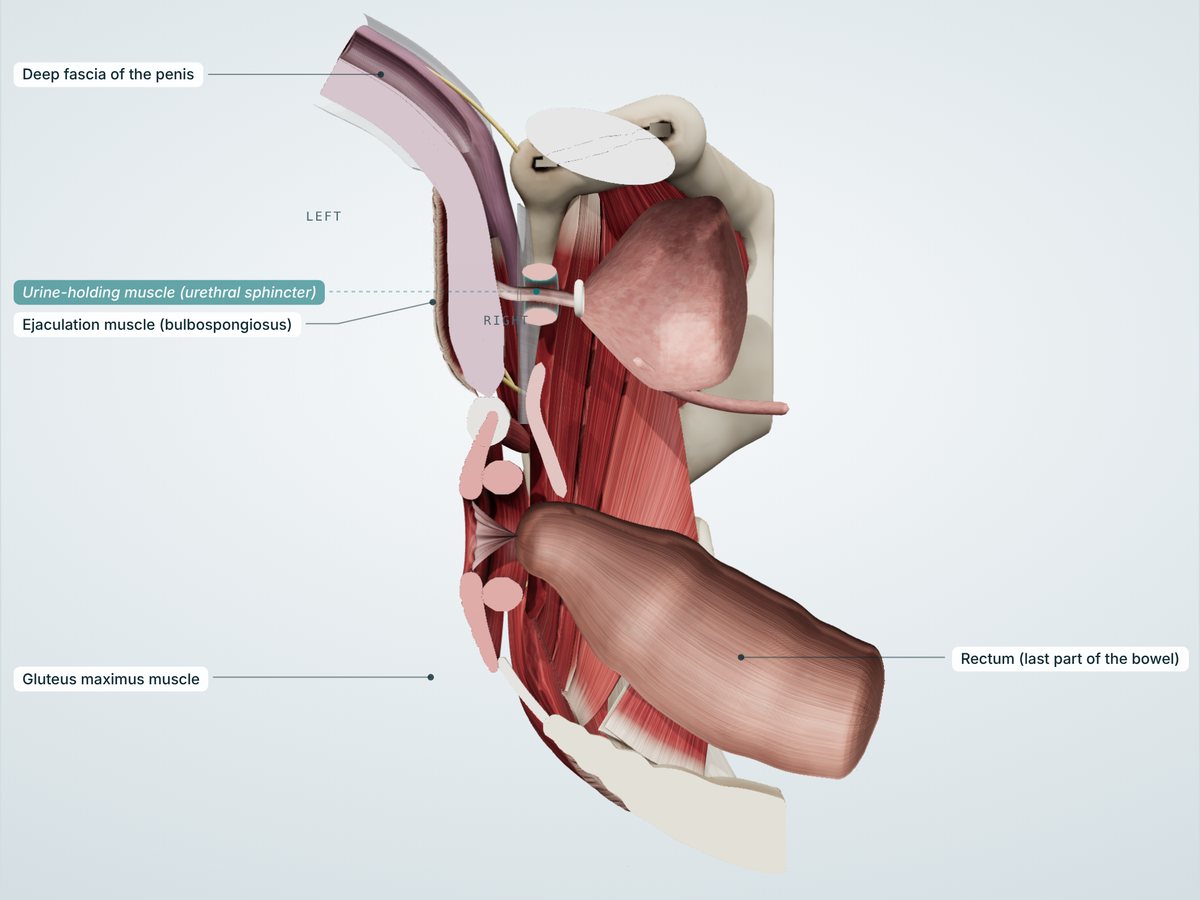
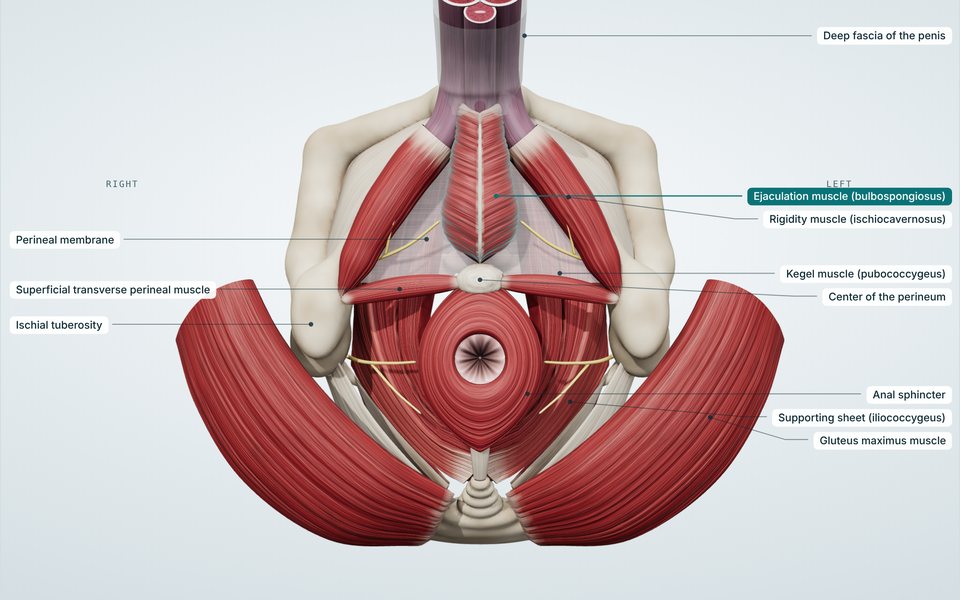 Interactive 3D modelSee the muscles that the training targetsTurn the pelvic floor, separate its layers, open a sagittal section that shows the join after prostatectomy, and follow a timed squeeze-and-release exercise on the model. A view for urologists and residents is included.Open the 3D model
Before the operation
Learning the muscle before surgery
Many men tighten the abdomen or the buttocks instead of the pelvic floor when they first try. Before surgery there is no catheter and no soreness, so the correct contraction is easier to learn. Whether an early start changes the result has been tested many times, with mixed answers.
Training started before the operation
| Study | Design | Result |
|---|---|---|
| Rangganata 2021 | Meta-analysis, 11 studies: training begun before surgery against training after surgery or none | Lower odds of leakage at 1, 3 and 6 months (odds ratios 0.58, 0.57 and 0.38). No difference at 12 months. |
| Brea-Gómez 2025 | Meta-analysis, 13 randomised trials of training with biofeedback before surgery | Less leakage up to 3 months (odds ratio 0.51), at 3 to 6 months (0.40) and at 6 to 12 months (0.29). Certainty of evidence very low to low. |
| Terzoni 2025 | Meta-analysis, 6 studies | More men continent at 3 months (odds ratio 1.52). No significant difference at 1, 6 or 12 months. |
| Wang 2014, Cheng 2020 | Meta-analyses of 5 randomised trials and of 18 studies | No significant difference at any time point. |
| Milios 2019 | Randomised, 97 men: a high-volume programme from 5 weeks before surgery against usual low-volume training | Less leakage on 24-hour pad weight and a faster return to continence in the first 12 weeks. |
The reviews disagree because the trials differ in the programme, the amount of supervision and the definition of continence. The EAU guideline concludes that preoperative training gives no additional benefit over training that starts after surgery (evidence level 1b). None of the reviews found a difference at 12 months.
After the operation
Training after the catheter is removed
Training is usually resumed when the catheter comes out, 7 to 10 days after surgery. At this practice the view is that pelvic floor physiotherapy after catheter removal can contribute greatly to the recovery of urinary control. The trials support this for the speed of recovery.
Training after the operation
| Study | Design | Result |
|---|---|---|
| Geng 2023 | Meta-analysis, 15 randomised trials, 2,178 men: training after surgery against none | Odds of leakage lower at 1 month (0.26), 3 months (0.30) and 6 months (0.20). At 12 months 0.85, not significant. |
| Filocamo 2005 | Randomised, 300 men after open surgery: structured training from catheter removal against no formal instruction | Continent at 1 month: 19% against 8%. At 6 months: 94.6% against 65%. |
| Ouchi 2024 | Randomised, 54 men, robotic surgery: supervised training from 2 months before surgery and for 12 months after it, against verbal instructions with a brochure | Median 24-hour pad weight at 3 months: 5 g against 21 g. Continent without pads at 12 months: 65.2% against 31.6%. |
| Sanchez-Salas 2023 | Randomised, 240 men leaking after robotic surgery: weekly biofeedback training for 3 months, duloxetine, both, or home exercises alone | Continent at 6 months: 90% with biofeedback training against 96% with home exercises alone, no significant difference. |
| Glazener 2011 (MAPS) | Randomised, 391 men still leaking 6 weeks after surgery: four therapist sessions over 3 months against standard care with lifestyle advice | Any leakage at 12 months: 76% against 77%. No significant difference. |
| Johnson 2023 (Cochrane) | Systematic review, 25 trials, 3,079 men | Combined conservative treatments: little difference in cure or improvement at 6 to 12 months (risk ratio 0.97). Overall value uncertain. |
In MAPS the comparison group also received written information on exercises, so the trial tested extra therapist sessions, not exercise against no exercise.
What the trials support
- Earlier control. Trained men were dry sooner in the first 6 months, in single trials and in the pooled analysis of 15 trials. In one trial in robotic surgery the difference was still present at 12 months.
- A recommendation in the guideline. The EAU guideline advises offering training, alone or with biofeedback or electrical stimulation, to speed the recovery of continence after radical prostatectomy (weak recommendation).
- Little to lose. No adverse effects were reported in the MAPS trial.
- Late starters. One randomised trial found a benefit in men who had been incontinent for at least a year and had never had training.
What they do not show
- A better final result. At 12 months the pooled difference was no longer significant, and in MAPS 76% and 77% still reported some leakage.
- That more supervision is always better. Two randomised trials found written instructions as good as supervised training, and in 240 men after robotic surgery weekly biofeedback sessions did no better than home exercises. The guideline calls the role of supervised training controversial.
- A best programme. No standard technique, number of contractions or duration has been established. Evidence on adding biofeedback or electrical stimulation is conflicting.
- High certainty. The 2023 Cochrane review describes the trials as mostly small and at risk of bias, and the value of conservative treatment as uncertain.
Sexual function
Erections and the pelvic floor
The muscles at the root of the penis compress the erectile tissue and help to keep blood in it during the rigid phase. This is the reason pelvic floor training has been tested for erections after prostate surgery. It is an addition to nerve-sparing surgery and penile rehabilitation, not a replacement for them.
Pelvic floor training and erectile function after prostatectomy
| Study | Design | Result |
|---|---|---|
| Prota 2012 | Randomised, 52 men: weekly biofeedback training for 3 months against verbal instructions | Potent at 12 months: 47.1% against 12.5%. Men who were continent were more likely to be potent. |
| Milios 2020 | Randomised, 97 men: high-volume training from 5 weeks before surgery against usual training | Less distress about erections 2 weeks after surgery. No conclusive difference in erectile function at 12 weeks. |
| Akdagcik 2026 | Systematic review, 12 randomised trials | Four trials found a benefit for erectile function and seven found no difference. Evidence limited by different programmes and risk of bias. |
Men who regain urinary control earlier can also start penile rehabilitation with more confidence. For the full picture see Erections after prostatectomy and nerve-sparing surgery.
In practice
How the training is done
The programme is set by a pelvic floor physiotherapist for each man. The outline below describes what the trials used and what the 3D model lets you follow.
Find the right muscle
The instruction matters. In an ultrasound and EMG study of healthy men, “shorten the penis” produced the strongest activity of the urethral sphincter, while “tighten around the anus” mainly worked the anal sphincter. “Stop the flow of urine” is a useful cue, but actually stopping the stream should not become a habit.
Slow holds and quick squeezes
Programmes mix contractions held for several seconds with short strong squeezes, in sets repeated through the day: 3 sets a day in usual care and 6 sets a day, done standing, in one randomised trial. The work moves from lying to sitting and standing.
Squeeze before the effort
Tightening just before a cough, a lift or standing up, sometimes called the knack, protects against the leak at the moment it would happen.
Let go fully
Every contraction ends with a complete release. Do not hold your breath or tighten the abdomen, buttocks or thighs. A pelvic floor that is tight or painful needs relaxation before strengthening.
Biofeedback and stimulation
Biofeedback shows the contraction on a screen and helps some men to find the muscle. Electrical stimulation may add a benefit in the first 6 months. For both, the trials do not agree.
Everyday habits
Walk daily, avoid heavy lifting in the first weeks and prevent constipation, because straining pushes on the pelvic floor. Pass urine at regular intervals instead of going “just in case”.
Timeline around the operation
- Before surgery
One visit to learn the contraction, then daily practice. Programmes in the trials began 3 weeks to 2 months before the operation.
- Day 1 to 10
Catheter in place. Walking and rest; training is resumed once the catheter is out.
- From catheter removal
Daily programme at home, reviewed by the physiotherapist. Leakage on coughing or standing up is common at first.
- Month 3 to 6
The period in which the trials show the difference. Training continues until control is steady.
- After 12 months
Leakage that is still bothersome is assessed again. A male sling or an artificial sphincter can then be discussed.
Patients from abroad: training starts when the catheter comes out, so book a pelvic floor physiotherapist near your home before you travel, ideally with one visit before surgery to learn the technique. You are given a medical letter that describes the operation for the physiotherapist and your own urologist.
Questions
Frequently asked questions
Do pelvic floor exercises work after prostate removal?
They bring urinary control back sooner. In a meta-analysis of 15 randomised trials with 2,178 men, training after surgery lowered the odds of leakage at 1, 3 and 6 months. At 12 months the difference was no longer significant, because most men improve with time. The benefit is clearer for the speed of recovery than for the final result.
Should I start before the operation?
It is reasonable, mainly to learn the technique while there is no catheter and no soreness. The meta-analyses disagree on whether starting early adds to the result: some found less leakage in the first 3 to 6 months, others found no difference, and none found a difference at 12 months. The European Association of Urology guideline concludes that preoperative training gives no additional benefit over training after surgery.
Do I need a physiotherapist, or are written instructions enough?
A physiotherapist who treats men after prostate surgery can check that you are using the right muscle, which many men get wrong at first. Once the technique is correct, the trials do not show a clear advantage of repeated supervised sessions: in the MAPS trial, four therapist sessions gave the same result at 12 months as standard care with written advice, and two other randomised trials found written instructions as good as supervised training. One trial in robotic surgery did find better continence at 12 months with a supervised programme that started before the operation.
How long should I continue?
Until control is steady, and usually for at least 3 months after the catheter is removed. Most programmes in the trials ran for 3 months; one randomised trial in robotic surgery continued for 12 months. Your physiotherapist adjusts the programme as you improve.
Can pelvic floor training help erections after surgery?
Possibly, as an addition to nerve-sparing surgery and penile rehabilitation. In one randomised trial of 52 men, 47.1% recovered potency at 12 months with weekly biofeedback training against 12.5% without it. A 2026 systematic review of 12 randomised trials found a benefit in four trials and no difference in seven, so the evidence is not settled.
Can I do too many exercises?
Yes. A pelvic floor that is held tight all day becomes tired and painful, and a muscle that cannot relax does not work well. Each contraction should be followed by a full release. If you have pelvic pain or difficulty starting the stream, relaxation is taught first.
What if I still leak a year after surgery?
Leakage that is still bothersome after 12 months is assessed again. Depending on the amount, a male sling or an artificial urinary sphincter can reduce it. Training can still help men who never had it: one randomised trial found a benefit in men who had been incontinent for at least a year without previous therapy.
Sources
The studies behind this page
- EAU Guidelines on the Management of Non-neurogenic Male Lower Urinary Tract Symptoms, including male urinary incontinence, 2026.
- Geng E, et al. The effect of perioperative pelvic floor muscle exercise on urinary incontinence after radical prostatectomy: a meta-analysis. Int Braz J Urol. 2023;49(4):441-451.
- Filocamo MT, et al. Effectiveness of early pelvic floor rehabilitation treatment for post-prostatectomy incontinence. Eur Urol. 2005;48(5):734-738.
- Ouchi M, et al. Physiotherapy for continence and muscle function in prostatectomy: a randomised controlled trial. BJU Int. 2024;134(3):398-406.
- Sanchez-Salas R, et al. Assessing the efficacy of pelvic floor muscle training and duloxetine on urinary continence recovery following radical prostatectomy: a randomized clinical trial. Prostate. 2024;84(2):158-165.
- Glazener C, et al. Urinary incontinence in men after formal one-to-one pelvic-floor muscle training following radical prostatectomy or transurethral resection of the prostate (MAPS). Lancet. 2011;378(9788):328-337.
- Johnson EE, et al. Conservative interventions for managing urinary incontinence after prostate surgery. Cochrane Database Syst Rev. 2023;4(4):CD014799.
- Rangganata E, et al. The effect of preoperative pelvic floor muscle training on incontinence problems after radical prostatectomy: a meta-analysis. Urol J. 2021;18(4):380-388.
- Brea-Gómez B, et al. Pelvic floor muscle training with preoperative biofeedback in patients with postprostatectomy incontinence: systematic review and meta-analysis. Eur Urol Focus. 2025;11(5):767-781.
- Terzoni S, et al. Preoperative pelvic muscle training for continence recovery after prostatectomy: yet another meta-analysis? Neurourol Urodyn. 2025;45(1):127-136.
- Wang W, et al. Effectiveness of preoperative pelvic floor muscle training for urinary incontinence after radical prostatectomy: a meta-analysis. BMC Urol. 2014;14:99.
- Cheng H, et al. Preoperative pelvic floor muscle exercise does not reduce the rate of postprostatectomy incontinence: a meta-analysis and systematic review. Transl Androl Urol. 2020;9(5):2146-2156.
- Milios JE, et al. Pelvic floor muscle training in radical prostatectomy: a randomized controlled trial of the impacts on pelvic floor muscle function and urinary incontinence. BMC Urol. 2019;19(1):116.
- Prota C, et al. Early postoperative pelvic-floor biofeedback improves erectile function in men undergoing radical prostatectomy: a prospective, randomized, controlled trial. Int J Impot Res. 2012;24(5):174-178.
- Milios JE, et al. Pelvic floor muscle training and erectile dysfunction in radical prostatectomy: a randomized controlled trial. Sex Med. 2020;8(3):414-421.
- Akdagcik Z, et al. Pelvic floor muscle training for erectile function in men undergoing radical prostatectomy: a systematic review of randomized controlled trials. World J Urol. 2026;44(1).
- Stafford RE, et al. Pattern of activation of pelvic floor muscles in men differs with verbal instructions. Neurourol Urodyn. 2016;35(4):457-463.
From the blog